Snow-Bound

John Greenleaf Whittier‘s most famous poem Snow-Bound,
is posted in the  Americana page above.

I recently found an 1897 copy of Whittier’s works printed for Houghton Mifflin by the Riverside Press in Cambridge, MA. The book was on the used book rack at my local supermarket and cost one dollar.  I had no idea how extensive Whittier’s output was. I also learned that he was a Quaker and an ardent abolitionist.

Snow-Bound is a long regional poem—but worth reading, especially if you know rural New England in winter.  And although it is regional, it is also global in its scope.  Wait until you are in the right mood. Until then, you can peruse the first few stanzas. If  your attention wanes,  go to the end and read the last stanzas.  You can always get to know this poem  section by section.

I love the description of the family friend, that …not unfeared, half welcome guest of a certain pard-like, treacherous grace who had been to Lebanon.

In the author’s  dedication he  says the following about the above-mentioned friend on p. 398 of my edition.   She was:

“…Harriet Livermore…of New Hampshire, a young woman of fine natural ability, enthusiastic, eccentric, with slight control over her violent temper , which sometimes made her religious profession doubtful. She was equally ready to exhort in school-house prayer meetings and dance in a Washington ball-room, while her father was a member of congress. She early embraced the doctrine of the Second Advent, and felt it her duty to proclaim the Lord’s speedy coming. With this message she crossed the Atlantic and spent the greater part of a long life in travelling over Europe and Asia. She lived some time with Lady Hester Stanhope, a woman as fantastic and mentally strained as herself, on the slope of Mt. Lebanon, but finally quarrelled with her in regard to two white horses with red marks on their backs which suggested the idea of saddles, on which her titled hostess expected to ride into Jerusalem with the Lord. A friend of mine found her, when quite an old woman, wandering in Syria with a tribe of Arabs, who with the Oriental notion that madness is inspiration, accepted her as their prophetess and leader. At the time referred to in Snow-Bound she was boarding at the Rocks Village about two miles from us.”

This description of Miss Livermore has greatly added to my appreciation of Snow-Bound. The poem was a best-seller back in the day, and earned  both money and nation-wide recognition for J.G. Whittier. There are so many lines of this poem that I could bring before you.  But I will leave you with these:

“Clasp, Angel of the backward look

And folded wings of ashen gray

And voice of echoes far away,

The brazen covers of thy book;

The weird palimpsest old and vast,

Wherein thou hid’st the spectral past;

Where, closely mingling, pale and glow

The characters of joy and woe;

The monographs of outlived years,

Or smile-illumed or dim with tears,

Green hills of life that slope to death,

And haunts of home, whose vistaed trees

Shade off to mournful cypresses

With the white amaranths underneath.”

That’s definitely  poetry.
Time to look up the word “palimpsest

Reeking Tubes & Iron Shards

Continuing in the 9-11 vein (hopefully injecting a  stimulant and not a sedative) I want to present before you lines from Psalm 48: 12-14   [NKJ version]

Walk about Zion, and go all around her.
         Count her towers;

 Mark well her bulwarks: consider her palaces;

 That you may tell it to the generation following.

 For this is God, our God forever and ever;                 

He will be our guide even to death.

  Let’s consider something here in light of human history and recent events.

Why does the psalmist exhort us to walk around the great city of Zion marking well her bulwarks and counting her towers?

So that we can inform the following generations of what the city looked like and where those towers were in our own day,  lest they forget.

Evidently  the great city of Zion had a skyline that did not endure from generation to generation.

Evidently even in Zion the towers and bulwarks were being demolished from time to time…

Which brings us to a great poem by Kipling  [written in 1897]:

Recessional

God of our fathers, known of old–
Lord of our far-flung battle line
Beneath whose awful hand we hold
Dominion over palm and pine–
Lord God of Hosts, be with us yet,
Lest we forget – lest we forget!

The tumult and the shouting dies;
The captains and the kings depart:
Still stands Thine ancient sacrifice,
An humble and a contrite heart.
Lord God of Hosts, be with us yet,
Lest we forget – lest we forget!

Far-called, our navies melt away;
On dune and headland sinks the fire:
Lo, all our pomp of yesterday
Is one with Nineveh and Tyre!
Judge of the Nations, spare us yet,
Lest we forget – lest we forget!

If, drunk with sight of power, we loose
Wild tongues that have not Thee in awe–
Such boasting as the Gentiles use
Or lesser breeds without the law–
Lord God of Hosts, be with us yet,
Lest we forget – lest we forget!

For heathen heart that puts her trust
In reeking tube and iron shard–
All valiant dust that builds on dust,
And guarding, calls not Thee to guard–
For frantic boast and foolish word,
Thy mercy on Thy people, Lord!

Satta Massagana

Means  “give thanks” in Amharic.

An Ethiopian graduate student lived with us in  the early 70’s.  She was very sweet and fun to be around. I was about 9 or 10  at the time. Maybe that is why I have always had a crush on Ethiopia. Ethiopia, did you hear me just now?  I still love you, girl. The wife understands – it’s OK.  Let’s be friends.

I love Ethiopian food. I love how they serve coffee with incense.  I love how they wear white robes in their Orthodox Church services.
This gets complicated very quickly.  You see, I also love Ethiopia because she was one of the first nations to receive the Gospel. Then there is the whole Biblical tie-in with Rastafari. It’s impossible to immerse yourself  in Roots music without eventually idealizing Ethiopia as Zion. Even if you’re a white boy. I know that is patriarchal of me – I’m so sorry, ladies.  I know it’s not fair to put Ethiopia on that pedestal (she’s just a woman, right?).
Actually, if you read the end of Kazantzakis’ fantastic novel The Last Temptation of Christ, Lucifer appears to Jesus on the cross as a beautiful Ethiopian cherub/seraph (they changed it in Scorsese’s film). It  just gets more and more complicated – sort of like a woman. Architecturally, artistically, gastronomically, theologically, rhythmically, I am fascinated by Ethiopia. Did you know that Ethiopia is the first nation mentioned by name in Genesis? I think God likes Ethiopia too (remember Moses’ wife…).
He even favored her BEFORE the flood. That’s antediluvian love, people.

Of course it’s not because their women are so lovely to behold, no.
But that is a bonus…

Today I want you to hear Satta Massagana by the Abyssinians, first recorded in 1969.

I could write pages on this stuff: Kazantzakis’ novel (all Christians need to read it!) which few of those who railed against the 1988 film even knew had been written in 1953), the glories of Abyssinia/Ethiopia/Kush, the antediluvian world, Roots Rock Reggae…but now you need to hear the music. It’s all about

“…a land far, far away / where there is no night / there is only day –
Look into the Book of Life and you will see
That  He /  He rules us all…”

(And this too is poetry).

A Deuce of O.B.E.s

OK  – I realize that I am addicted to working on this blog, primitive as it is. Compared to other addictive tendencies I possess, this one is positive and therapeutic – so I better go with it.    Come with me.

This is a decentralized poetry blog. For me, poetry should be finely wrought, highly structured, rhythmic, rhyming mystery.  I also prefer a clear, enduring message in poetry rather than ephemeral observations or frivolous meanderings. Mystery conveying clear messages…hmmmm.  Poetic preferences  get harder to pin down as we try to define them.

I also  don’t want to go where Pablo Saborio goes. As an ex-Nihilist (yes, I am a Christian who still reads Nietzsche) I can say that I really like the graphic style of his blog, but there is too much word-collage and dark verborrhea there  for my taste. My island of intensity is situated in other seas and uncharted archipelagos.

What you are likely to find on my island of intensity: disjunctures, 17th/18th century poetry, musings on the lost civilization of Atlantis, semi-coherent superficial references to the Rhizomatic philosophy of Deleuze & Guattari , death-trips and resurrection epiphanies, highbrow, lowbrow, pop, surreal and psycho-art, rock’n’roll, Rastafari, delusions of grandeur with undercurrents of self-loathing,  smatterings of Romance language, our Lord and Savior Jesus Christ, etc.

Therefore, in the name of Poetry, today I bring you two Out of Body Experiences [OBEs].  (Isn’t that what good poetry should do – take us out of our bodies?)  Those of you who dismiss such things TURN BACK NOW.  You are not meant to be here. Go check out that cooking blog, or  scan the sports pages, OK?

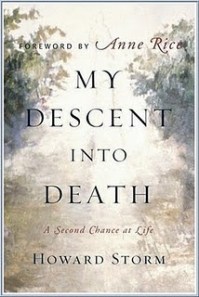
The first is Howard Storm. Have you ever read a book that spoke so insightfully to you that you felt like buying a case from the publisher to distribute to all your friends? My Descent Into Death is one of those. Storm was an art history professor,  artist, and a declared atheist  – until a perforated ulcer in the City of Light took him down to hell, then up to Heaven, with the result that he became a  pastor. You can find many interviews with him on YouTube. They are highly recommended. Anne Rice [of vampire fame]wrote the foreword. You can read a lot of excerpts here. I return to this book over and over when overwhelmed with despair. Please read it.

The second is that of Ian McCormack. He was a New Zealander, and a surf bum, riding the wave of an Endless Summer existence – until he got stung five times by  Box Jellyfish.            One sting can be lethal to a grown adult. Here is a link to his testimony. It is an amazing read.   People – if  this stuff is true, if  these two men really lived these experiences, then a great reevaluation of the very foundations of our lives is called for. You can try to ignore these things but they are out there – these are only two OBEs. There are endless testimonies of this type.

Are you living your life today in light of Eternity – the absolute reality of eternity? Are you hoping it’s all just chemical dissociation due to physical stress? Do you immediately mock those who bring us these reports?

Yes – I AM preaching. Preaching is also a valuable form of poetry.

Preaching is a highly  esteemed art on my island of intensity.          Have a nice eternity.