Pastoral Lays & Arcadian Cantos


Attend, ye Nine, and careless swains:
descending to Arcadia’s plains
a playful Zephyr wind of love
now stirs the leaves of Venus‘ grove.

By Philomela‘s unshorn flocks
and bright Diana‘s flowing locks
my classic naiad air now brings
a gushing fountain’s hidden springs.
O’er verdant fields and greening rill
my lay shall fauns with satyrs thrill.
Ye swains and shepherdesses, come!
Adore the world’s Arcadian bum.

Flora, banished from Eden, thrives
Sweetening hidden honey hives
whose swarms of workers never tire
providing flow’ry heart’s desire.

Cupid spreads his fluttering plumes;
and Nature wanton pose assumes
uncovering her dales and glades
before her early glory fades.
The captivating limbs of grace
now parted, show her lower face,
where clefts are glimpsed—ravines, or chasms;
shuddering, bursting forth in spasms.
Earth thus trembles. See her quake
and ruin of GOD’s creation make.

Wisdom, fallen, pawns her crown
as high ideals come crashing down.
So o’er the fields, my pastoral lay
sets Aeolus blowing on his way.
Now thyrsus-bearing maenads pass
and Bacchus rides upon his ass.
(A different ass should be adored
that fair creation of the LORD,
which gently rounded, swells the mind
with thoughts unhallowed, unrefined.)
This second ass we long to ride;
until she comes—our load inside.
But burdened beasts deserve no spite,
nor does my Poetry, despite
the fact that Porn has made us dumb
reducing us to spurts of come . . .
So chaste (and chased) celestial virgins
turn to trees at Classic urgings.

Eros spreads his wings (her legs)
inviting us to drain the dregs
while Ceres‘ tawny limbs now shake
as harvests man would undertake.
Old Pan gives rise to Attic fears
(as well the sav’ry bacon sears),
whose pipes the purling brooks enjoy
and streams flow faster, for their joy.
The golden past see here, anew
in rosy and poetic hue:
Will nature be reduced to porn?
Shall nymphs of pleasure, newly born
who bare their charming whole to all
cast womanhood in a dying fall
before a camera, there, to fawn
and light the rosy-fingered dawn?
If so, I say let’s get it lit
(since literature might help a bit)
and in the daybreak’s fervid light
we’ll now make out fair nature’s sight:
appendages outspread, well-splayed
where once the sprite and dryad played.
Such fertile pastures, mounds, and woods,
a panoply of carnal goods
our undulating field of bliss
make misconceptions: hit and miss.
These wetlands, groves, and bounteous limbs
enthralled to lust’s capricious whims
make sweet Diana seek her quarry.
(far too late to say I’m sorry . . .)
Sex, our motivating prize
displayed in fleshly glory lies.
Her fanes are reared, which sounds obscene
where once raw Nature reigned serene.
Halcyon visions of the hunt
direct our carnal minds to C – – t!
The blessed light, transcending hope
and rolling o’er each grassy slope
begins to shine on darkened waters,
stirring up the river daughters;
waking schools of silvery fish
who glide along their final wish:
to flee the sharpened hook of fate
upon which squirms the Master’s bait.
While Phoebus floods the surface bright
with beams of pure poetic light.

This Heaven, following hard on Hell
is less a Babylonian spell
than pure devotion, misdirected
(and a pagan shrine erected).
where the poets sing too long.
Now hearken well: I’ll close my song.
Don’t harden your dull heart in hate;
just glimpse the garden from her gate.
And view those less celestial skies
receding in her human eyes
Until these dear idyllic scenes
inspired by purely digital means
reveal, at last, a digital end
and past with present bravely blend.

Enough of flocks of stinking sheep
who eat and wander, bleat and sleep.
Who copulate, and piss and shit
as if their lives depend on it . . .
Instead, I’ll sing of human being
beneath the eye of One all-seeing.
Ye watchers of the erring flock,
and pastors whom the crowing cock
awakes from sleep’s Elysian fields,
attune your souls. My poem yields
an end to this Arcadian story
(it was naught but allegory).
Such fleshly charms are quite a treat
and mutton-chops make hearty meat.
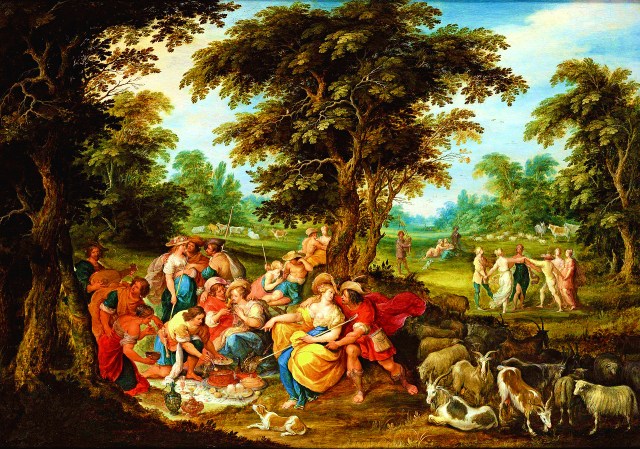
An Invitation To Dafnis

When such a day, blessed the Arcadian plain,
Warm without Sun, and shady without rain,
Fann’d by an air, that scarcely bent the flowers,
Or wav’d the woodbines, on the summer bowers,
The Nymphs disorder’d beauty could not fear,
Nor ruffling winds uncurld the Shepherd’s hair,
On the fresh grass, they trod their measures light,
And a long Evening made, from noon, to night.
Come then my Dafnis, from those cares descend
Which better may the winter season spend.
Come, and the pleasures of the fields, survey,
And through the groves, with your Ardelia stray.
Reading the softest Poetry, refuse,
To view the subjects of each rural muse;
Nor let the busy compasses go round,
When faery Circles better mark the ground.
Rich Colours on the Vellum cease to lay,
When ev’ry lawn much nobler can display,
When on the dazzling poppy may be seen
A glowing red, exceeding your carmine;
And for the blew that o’re the Sea is borne,
A brighter rises in our standing corn.
Come then, my Dafnis, and the fields survey,
And through the groves, with your Ardelia stray.
Come, and let Sansons World, no more engage,
Although he gives a Kingdom in a page;
O’re all the Universe his lines may go,
And not a clime, like temp’rate Britain show,
Come then, my Dafnis, and her fields survey,
And through the groves, with your Ardelia stray.
Nor plead that you’re immur’d, and cannot yield,
That mighty Bastions keep you from the field,
Think not tho’ lodg’d in Mons, or in Namur,
You’re from my dangerous attacks secure.
No, Louis shall his falling Conquests fear,
When by succeeding Couriers he shall hear
Apollo, and the Muses, are drawn down,
To storm each fort, and take in ev’ry Town.
Vauban, the Orphean Lyre, to mind shall call,
That drew the stones to the old Theban Wall,
And make no doubt, if itt against him play,
They, from his works, will fly as fast away,
Which to prevent, he shall to peace persuade,
Of strong, confederate Syllables, afraid.
Come then, my Dafnis, and the fields survey,
And through the Groves, with your Ardelia stray.
Come, and attend, how as we walk along,
Each cheerful bird, shall treat us with a song,
Not such as Fopps compose, where wit, nor art,
Nor plainer Nature, ever bear a part;
The Crystal springs, shall murmur as we pass,
But not like Courtiers, sinking to disgrace;
Nor, shall the louder Rivers, in their fall,
Like unpaid Saylers, or hoarse Pleaders brawl;
But all shall form a concert to delight,
And all to peace, and all to love invite.
Come then, my Dafnis, and the fields survey,
And through the Groves, with your Ardelia stray.
As Baucis and Philemon spent their lives,
Of husbands he, the happiest she, of wives,
When through the painted meads, their way they sought,
Harmlesse in act, and unperplext in thought,
Let us my Dafnis, rural joys persue,
And Courts, or Camps, not ev’n in fancy view.
So, let us through the Groves, my Dafnis stray,
And so, the pleasures of the fields, survey.

by Anne Finch (1661-1720)

Pastoral Dialogue: DERMOT & SHEELA

A Nymph and swain, Sheelah and Dermot hight;
Who wont to weed the court of Gosford knight;
While each with stubbed knife removed the roots,
That raised between the stones their daily shoots;

As at their work they sate in counterview,
With mutual beauty smit, their passion grew.
Sing, heavenly Muse, in sweetly flowing strain,
The soft endearments of the nymph and swain.

DERMOT

My love to Sheelah is more firmly fixt,
Than strongest weeds that grow those stones betwixt;
My spud these nettles from the stones can part;
No knife so keen to weed thee from my heart.

SHEELAH

My love for gentle Dermot faster grows,
Than yon tall dock that rises to thy nose.
Cut down the dock, ’twill sprout again; but, O!
Love rooted out, again will never grow.

DERMOT

No more that brier thy tender leg shall rake:
(I spare the thistles for Sir Arthur’s sake)
Sharp are the stones; take thou this rushy mat;
The hardest bum will bruise with sitting squat.

SHEELAH

Thy breeches, torn behind, stand gaping wide;
This petticoat shall save thy dear backside;
Nor need I blush; although you feel it wet,
Dermot, I vow, ’tis nothing else but sweat.

DERMOT

At an old stubborn root I chanced to tug,
When the Dean threw me this tobacco-plug;
A longer ha’p’orth never did I see;
This, dearest Sheelah, thou shall share with me.

SHEELAH

In at the pantry door, this morn I slipt,
And from the shelf a charming crust I whipt:
Dennis was out, and I got hither safe;
And thou, my dear, shall have the bigger half.

DERMOT

When you saw Tady at long bullets play,
You sate and loused him all a sunshine day:
How could you, Sheelah, listen to his tales,
Or crack such lice as his between your nails?

SHEELAH

When you with Oonah stood behind a ditch,
I peep’d, and saw you kiss the dirty bitch;
Dermot, how could you touch these nasty sluts?
I almost wish’d this spud were in your guts.

DERMOT

If Oonah once I kiss’d, forbear to chide;
Her aunt’s my gossip by my father’s side:
But, if I ever touch her lips again,
May I be doom’d for life to weed in rain!

SHEELAH

Dermot, I swear, though Tady’s locks could hold
Ten thousand lice, and every louse was gold;
Him on my lap you never more shall see;
Or may I lose my weeding knife—and thee!

DERMOT

O, could I earn for thee, my lovely lass,
A pair of brogues to bear thee dry to mass!
But see, where Norah with the sowins comes—
Then let us rise, and rest our weary bums.

Jonathan Swift (1667-1745)