Anne Finch: Pastoral Fixations

A simple life that shepherd leads
On Mountains tops or flowry meads
Nor from his mole-hill dares aspire
Majestick beauty to admire
But to the village come at night
Some milk-maid proves his low delight

[…]

Then let me hear no more of Swains
Those rustick saunterers on the plains
Who ne’er had Pastoral or reed
But what from Poets did proceed

extract from:
To the Right Honorable the Lord Viscount Hatton by Way of Excuse for My Having Not in Sometime Replied to His Last Copy of Verses in Which He Gives Himself the Name of Corydon Not Approved by Me Who in This Poem Offer at an Imitation of Madame Deshouliers in Her Way of Badinage


A Pastoral Dialogue Between Two Shepherdesses


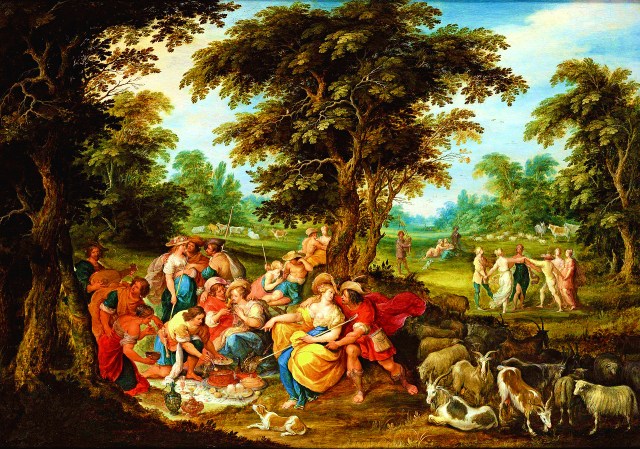
[Silvia] Pretty Nymph! within this Shade,
Whilst the Flocks to rest are laid,
Whilst the World dissolves in Heat,
Take this cool, and flow’ry Seat:
And with pleasing Talk awhile
Let us two the Time beguile;
Tho’ thou here no Shepherd see,
To encline his humble Knee,
Or with melancholy Lays
Sing thy dangerous Beauty’s Praise.
[Dorinda] Nymph! with thee I here wou’d stay,
But have heard, that on this Day,
Near those Beeches, scarce in view,
All the Swains some Mirth pursue:
To whose meeting now I haste.
Solitude do’s Life but waste.
[Silvia] Prithee, but a Moment stay.
[Dorinda] No! my Chaplet wou’d decay;
Ev’ry drooping Flow’r wou’d mourn,
And wrong the Face, they shou’d adorn.
[Silvia] I can tell thee, tho’ so Fair,
And dress’d with all that rural Care,
Most of the admiring Swains
Will be absent from the Plains.
Gay Sylvander in the Dance
Meeting with a shrew’d Mischance,
To his Cabin’s now confin’d
By Mopsus, who the Strain did bind:
Damon through the Woods do’s stray,
Where his Kids have lost their way:
Young Narcissus iv’ry Brow
Rac’d by a malicious Bough,
Keeps the girlish Boy from sight,
Till Time shall do his Beauty right.
[Dorinda] Where’s Alexis?
[Silvia] -He, alas!
Lies extended on the Grass;
Tears his Garland, raves, despairs,
Mirth and Harmony forswears;
Since he was this Morning shown,
That Delia must not be his Own.
[Dorinda] Foolish Swain! such Love to place.
[Silvia] On any but Dorinda’s Face.
[Dorinda] Hasty Nymph! I said not so.
[Silvia] No-but I thy Meaning know.
Ev’ry Shepherd thou wou’d’st have
Not thy Lover, but thy Slave;
To encrease thy captive Train,
Never to be lov’d again.
But, since all are now away,
Prithee, but a Moment stay.
[Dorinda] No; the Strangers, from the Vale,
Sure will not this Meeting fail;
Graceful one, the other Fair.
He too, with the pensive Air,
Told me, ere he came this way
He was wont to look more Gay.
[Silvia] See! how Pride thy Heart inclines
To think, for Thee that Shepherd pines;
When those Words, that reach’d thy Ear,
Chloe was design’d to hear;
Chloe, who did near thee stand,
And his more speaking Looks command.
[Dorinda] Now thy Envy makes me smile.
That indeed were worth his while:
Chloe next thyself decay’d,
And no more a courted Maid.
[Silvia] Next myself! Young Nymph, forbear.
Still the Swains allow me Fair,
Tho’ not what I was that Day,
When Colon bore the Prize away;
When-
[Dorinda] -Oh, hold! that Tale will last,
Till all the Evening Sports are past;
Till no Streak of Light is seen,
Nor Footstep prints the flow’ry Green.
What thou wert, I need not know,
What I am, must haste to show.
Only this I now discern
From the things, thou’d’st have me learn,
That Woman-kind’s peculiar Joys
From past, or present Beauties rise.

by Anne Finch (1661-1720)

Poetic Pastures (pt. II)

It is by rules like these that we ought to judge of Pastoral. And since the instructions given for any art are to be delivered as that art is in perfection, they must of necessity be derived from those in whom it is acknowledged so to be. It is therefore from the practice of Theocritus and Virgil (the only undisputed authors of Pastoral) that the critics have drawn the foregoing notions concerning it.
Theocritus excels all others in nature and simplicity. The subjects of his Idyllia are purely pastoral; but he is not so exact in his persons, having introduced reapers and fishermen as well as shepherds. He is apt to be too long in his descriptions, of which that of the cup in the first pastoral is a remarkable instance. In the manners he seems a little defective, for his swains are sometimes abusive and immodest, and perhaps too much inclining to rusticity; for instance, in his fourth and fifth Idyllia. But it is enough that all others learned their excellences from him, and that his dialect alone has a secret charm in it, which no other could ever attain.

Virgil, who copies Theocritus, refines upon his original; and, in all points where judgment is principally concerned, he is much superior to his master. Though some of his subjects are not pastoral in themselves, but only seem to be such, they have a wonderful variety in them, which the Greek was a stranger to. He exceeds him in regularity and brevity, and falls short of him in nothing but simplicity and propriety of style; the first of which, perhaps, was the fault of his age, and the last of his language.

Among the moderns their success has been greatest who have most endeavoured to make these ancients their pattern. The most considerable genius appears in the famous Tasso, and our Spenser. Tasso, in his Aminta, has as far excelled all the pastoral writers, as in his Gierusalemme he has outdone the epic poets of his country. But as this piece seems to have been the original of a new sort of poem, the pastoral comedy, in Italy, it cannot so well be considered as a copy of the ancients. Spenser’s Calender, in Mr. Dryden’s opinion, is the most complete work of this kind which any nation has produced ever since the time of Virgil Not but that he may be thought imperfect in some few points: his eclogues are somewhat too long, if we compare them with the ancients; he is sometimes too allegorical, and treats of matters of religion in a pastoral style, as the Mantuan had done before him; he has employed the lyric measure, which is contrary to the practice of the old poets; his stanza is not still the same, nor always well chosen. This last may be the reason his expression is sometimes not concise enough; for the tetrastic has obliged him to extend his sense to the length of four lines, which would have been more closely confined in the couplet.

In the manners, thoughts, and characters, he comes near to Theocritus himself; though, notwithstanding all the care he has taken, he is certainly inferior in his dialect: for the Doric had its beauty and propriety in the time of Theocritus; it was used in part of Greece, and frequent in the mouths of many of the greatest persons: whereas the old English and country phrases of Spenser were either entirely obsolete, or spoken only by people of the lowest condition. As there is a difference betwixt simplicity and rusticity, so the expression of simple thoughts should be plain, but not clownish. The addition he has made of a calendar to his eclogues is very beautiful; since by this, besides the general moral of innocence and simplicity, which is common to other authors of Pastoral, he has one peculiar to himself; he compares human life to the several seasons, and at once exposes to his readers a view changes and aspects. Yet the scrupulous division of his pastorals into months has obliged him either to repeat the same description, in other words, for three months together, or, when it was exhausted before, entirely to omit it; whence it comes to pass that some of his eclogues (as the sixth, eighth, and tenth for example) have nothing but their titles to distinguish them. The reason is evident, because the year has not that variety in it to furnish every month with a particular description, as it may every season.

Of the following eclogues I shall only say, that these four comprehend all the subjects which the critics upon Theocritus and Virgil will allow to be fit for Pastoral; that they have as much variety of description, in respect of the several seasons, as Spenser’s; that, in order to add to this variety, the several times of the day are observed, the rural employments in each season or time of day, and the rural scenes or places proper to such employments, not without some regard to the several ages of man, and the different passions proper to each age.

But after all, if they have any merit, it is to be attributed to some good old authors; whose works, as I had leisure to study, so, I hope, I have not wanted care to imitate.

Discourse on Pastoral Poetry by Alexander Pope (1688–1744)

Poetic Pastures

There are not, I believe, a greater number of any sort of verses than of those which are called Pastorals; nor a smaller than of those which are truly so. It therefore seems necessary to give some account of this kind of poem; and it is my design to comprise in this short paper the substance of those numerous dissertations that critics have made on the subject, without omitting any of their rules in my own favour. You will also find some points reconciled, about which they seem to differ, and a few remarks which, I think, have escaped their observation.

The origin of Poetry is ascribed to that age which succeeded the creation of the world: and as the keeping of flocks seems to have been the first employment of mankind, the most ancient sort of poetry was probably pastoral. It is natural to imagine, that the leisure of those ancient shepherds admitting and inviting some diversion, none was so proper to that solitary and sedentary life as singing; and that in their songs they took occasion to celebrate their own felicity. From hence a poem was invented, and afterwards improved to a perfect image of that happy time; which, by giving us an esteem for the virtues of a former age, might recommend them to the present. And since the life of shepherds was attended with more tranquillity than any other rural employment, the poets chose to introduce their persons, from whom it received the name of Pastoral.

A Pastoral is an imitation of the action of a shepherd, or one considered under that character. The form of this imitation is dramatic, or narrative, or mixed of both: the fable simple, the manners not too polite nor too rustic: the thoughts are plain, yet admit a little quickness and passion, but that short and flowing: the expression humble, yet as pure as the language will afford; neat, but not florid; easy, and yet lively. In short, the fable, manners, thoughts, and expressions are full of the greatest simplicity in nature.

The complete character of this poem consists in simplicity, brevity, and delicacy; the two first of which render an eclogue natural, and the last delightful.

If we would copy nature, it may be useful to take this idea along with us, that Pastoral is an image of what they call the golden age: so that we are not to describe our shepherds as shepherds at this day really are, but as they may be conceived then to have been, when the best of men followed the employment. To carry this resemblance yet further, it would not be amiss to give these shepherds some skill in astronomy, as far as it may be useful to that sort of life; and an air of piety to the gods should shine through the poem, which so visibly appears in all the works of antiquity; and it ought to preserve some relish of the old way of writing: the connection should be loose, the narrations and descriptions short, and the periods concise. Yet it is not sufficient that the sentences only be brief; the whole eclogue should be so too: for we cannot suppose poetry in those days to have been the business of men, but their recreation at vacant hours.

But, with respect to the present age, nothing more conduces to make these composures natural, than when some knowledge in rural affairs is discovered. This may be made to appear rather done by chance than on design, and sometimes is best shown by inference; lest, by too much study to seem natural, we destroy that easy simplicity from whence arises the delight. For what is inviting in this sort of poetry proceeds not so much from the idea of that business, as of the tranquillity of a country life.

We must therefore use some illusion to render a pastoral delightful; and this consists in exposing the best side only of a shepherd’s life, and in concealing its miseries. Nor is it enough to introduce shepherds discoursing together in a natural way; but a regard must be had to the subject; that it contain some particular beauty in itself, and that it be different in every eclogue. Besides, in each of them a designed scene or prospect is to be presented to our view, which should like wise have its variety. This variety is obtained, in a great degree, by frequent comparisons, drawn from the most agreeable objects of the country; by interrogations to things inanimate; by beautiful digressions, but those short; sometimes by insisting a little on circumstances; and, lastly, by elegant turns on the words, which render the numbers extremely sweet and pleasing. As for the numbers themselves, though they are properly of the heroic measure, they should be the smoothest, the most easy and flowing imaginable.

Discourse on Pastoral Poetry by Alexander Pope (1688–1744)