For This Let Men Revile My Name

 My friend, brother and hymnologist shared this poem with me.
(Calling it a “poem” is almost demeaning. I should say he shared these stupendous words of eternal life with me…and I am grateful)

Shall I, For Fear of Feeble Man

Shall I, for fear of feeble man,
The Spirit’s course in me restrain?
Or, undismayed, in deed and word
Be a true witness for my Lord?

Awed by a mortal’s frown, shall I
Conceal the Word of God most high?
How then before Thee shall I dare
To stand, or how Thine anger bear?

Shall I, to soothe the unholy throng,
Soften Thy truths, and smooth my tongue,
To gain earth’s gilded toys, or flee
The cross, endured, my God, by Thee?

What then is he whose scorn I dread,
Whose wrath or hate makes me afraid?
A man! an heir of death! a slave
To sin! a bubble on the wave!

Yea, let men rage, since Thou wilt spread
Thy shadowing wings around my head;
Since in all pain Thy tender love
Will still my sure refreshment prove.

Savior of men, Thy searching eye
Doth all my inmost thoughts descry;
Doth aught on earth my wishes raise,
Or the world’s pleasures, or its praise?

The love of Christ doth me constrain
To seek the wandering souls of men;
With cries, entreaties, tears, to save,
To snatch them from the gaping grave.

For this let men revile my name.
No cross I shun, I fear no shame,
All hail, reproach, and welcome, pain!
Only Thy terrors, Lord, restrain.

My life, my blood, I here present,
If for Thy truth they may be spent,
Fulfill Thy sovereign counsel, Lord!
Thy will be done, Thy name adored!

Give me Thy strength, O God of power;
Then let winds blow, or thunders roar,
Thy faithful witness will I be:
’Tis fixed; I can do all through Thee!
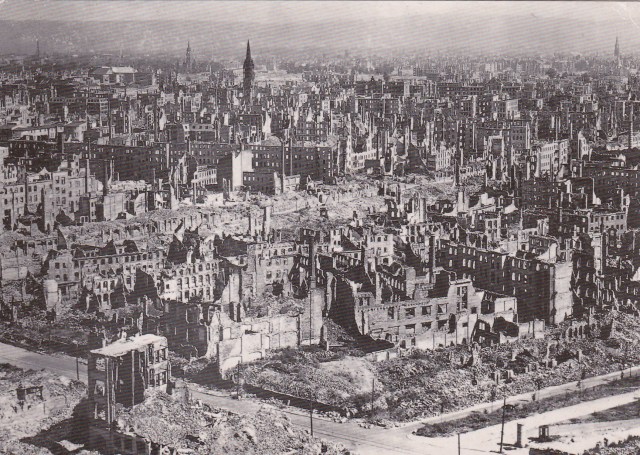
Jo­hann J. Wink­ler,1708
trans­lat­ed from Ger­man by John Wes­ley, Hymns and Sac­red Po­ems, 1739

Fires of Dresden

dresden

The finest china in the world is burned at least three times, some of it more than three times. Dresden china is always burned three times. Why does it go through that intense fire? Once ought to be enough; twice ought to be enough. No, three times are necessary to burn that china so that the gold and the crimson are brought out more beautiful and then fastened there to stay.

We are fashioned after the same principle in human life. Our trials are burned into us once, twice, thrice; and by God’s grace these beautiful colors are there and they are there to stay forever.                                                                  (Cortland Myers)


Earth’s fairest flowers grow not on sunny plain,

But where some vast upheaval rent in twain The smiling land . . . .

After the whirlwinds devastating blast,

After the molten fire and ashen pall,

God’s still small voice breathes healing over all.

From riven rocks and fern-clad chasms deep,

Flow living waters as from hearts that weep,

There in the afterglow soft dews distill

And angels tend God’s plants when night falls still,

And the Beloved passing by that way

Will gather lilies at the break of day.

J.H.D.
from: Streams in the Desert  Copyright © 2012
The Good News Broadcasting Association, Inc. (Back to the Bible) Lincoln, Nebraska, USA
Used by permission. All rights reserved backtothebible.org
image:  sabinemcneill

W. H. Auden Walks Out

As I walked Out One Evening held me transfixed from the start.
It must have been in 1992. We were bumping along through the desert canyons of Arizona, near Florence, a bunch of dusty art students on a landscape-painting trip. Our trip leader brought us deep into the recesses of Box Canyon, into some of the most gorgeous and awe-inspiring landscapes I have ever beheld. There was a battered anthology of poems in the van, so some of us were reading poems out loud to each other. My friend read this one and I loved it the first time I heard it. At one point I learned it by heart  but now only a few stanzas are still there in my memory. It grows on me every time I read it.

As in Song from the Coptic by J. Mangan, I love the juxtaposition of the continents and countries in those  great  lines:

I’ll love you, dear, I’ll love you / Till China and Africa meet,
And the river jumps over the mountain / And the salmon sing in the street…

Then comes a sudden shift into existential horror after stanza 5:

But all the clocks in the city Began to whirr and chime…

“The burrows of the nightmare…” reminds one of parts of De Quincy’s Confessions, which is the best whacked-out yet articulate description of hallucinatory horror I have read. The chimes themselves are here.

I can picture so many of Auden’s  images: the cracked tea-cup, the threaded dances, the beggar with a wad of cash.  The “diver’s brilliant bow” is a strange image. Did he mean a rainbow? Something a diver would use to hunt fish? I sometimes see it as a berimbau—one of those Brazilian string instruments.

The poem begins and ends with the brimming river, which at the beginning seemed to brim with possibility but by the end has overflowed with melancholy. Yet it still holds out hope:

Life remains a blessing / Although you cannot bless.

We must strive to love our neighbors with our own sinful hearts.  It is about disillusion creeping into life and the subsequent need for perseverance and faith in the face of  “appalling snow” and glaciers creeping into what were the verdant fields of youth and idealism.

How do you interpret this poem?  Do you like this poem?

Smokin’ Pipes! (Vital Organ)

Yes Virginia, words DO have meaning.
In spite of all that my postmodernist professors have said,
words have meaning… especially when arranged in sentences.

[Just ask Madonna.]

Here is a magnificent text for all you cutting-edge linguistic hipsters to deconstruct, heteroglossically demythologize, and ontologically implode through polylectic subtextual analysis.

OMG –  it doesn’t get much better than this!       (…or DOES  it ? )

Isn’t this where the expression “pull out all the stops” comes from ?

For all the saints, who from their labors rest,
who thee by faith before the world confessed,
thy Name, O Jesus, be forever blessed.
Alleluia, Alleluia!

Thou wast their Rock, their Fortress and their Might;
thou, Lord, their Captain in the well fought fight;
thou, in the darkness drear, their one true Light.
Alleluia, Alleluia!

For the apostles’ glorious company,
who bearing forth the cross o’er land and sea,
shook all the mighty world, we sing to Thee:
Alleluia, Alleluia!

For the Evangelists, by whose blest word,
like fourfold streams, the garden of the Lord,
is fair and fruitful, be thy Name adored.
Alleluia, Alleluia!

For Martyrs, who with rapture kindled eye,
saw the bright crown descending from the sky,
and seeing, grasped it, thee we glorify.
Alleluia, Alleluia!

O may thy soldiers, faithful, true, and bold,
fight as the saints who nobly fought of old,
and win, with them the victor’s crown of gold.
Alleluia, Alleluia!

O blest communion, fellowship divine!
we feebly struggle, they in glory shine;
all are one in thee, for all are thine.
Alleluia, Alleluia!

And when the strife is fierce, the warfare long,
steals on the ear the distant triumph song,
and hearts are brave, again, and arms are strong.
Alleluia, Alleluia!

The golden evening brightens in the west;
soon, soon to faithful warriors comes their rest;
sweet is the calm of paradise the blessed.
Alleluia, Alleluia!

But lo! there breaks a yet more glorious day;
the saints triumphant rise in bright array;
the King of glory passes on his way.
Alleluia, Alleluia!

From earth’s wide bounds, from ocean’s farthest coast,
through gates of pearl streams in the countless host,
and singing to Father, Son and Holy Ghost:
Alleluia, Alleluia!

William W. How   (1823-1897)
Thanks to:    http://www.oremus.org