Old-school Lyrics: Doom

Michael Wigglesworth (1631—1705)


Some plead examples of their betters.

CXIV.

Then were brought in and charg’d with sin,
another Company,
Who by Petition obtain’d permission
to make Apology.
They arguéd, “We were misled,
as is well known to thee.
By their example that had more ample
abilities than we;

CXV.

“Such, as profess’d they did detest
and hate each wicked way;
Whose seeming grace whilst we did trace,
our Souls were led astray.
When men of Parts, Learning, and Arts,
professing Piety,
Did thus and thus, it seem’d to us
we might take liberty.“

Who are told that examples are no Rules.

CXVI.

The Judge replies: “I gave you eyes,
And light to see your way,
Which had you lov’d and well improv’d,
you had not gone astray.
My Word was pure, the Rule was sure;
Why did you it forsake,
Or thereon trample, and men’s example
your Directory make?

CXVII.

“This you well knew: that God is true,
and that most men are liars,
In word professing holiness,
in deed thereof deniers.
simple fools! that having Rules,
your lives to regulate.
Would them refuse, and rather choose
vile men to imitate.“

They urge that they were led by godly men’s Examples.
But all their shifts turn to their greater shame.

CXVIII.

“But, Lord,” say they, “we went astray,
and did more wickedly,
By means of those whom thou has chose
Salvation’s heirs to be.“
To whom the Judge: “What you allege
doth nothing help the case,
But makes appear how vile you were,
and rend’reth you more base.

CXIX.

“You understood that what was good,
was to be followéd.
And that you ought that which was naught
to have relinquished.
Contrariwise it was your guise
only to imitate
Good men’s defects, and their neglects
who were regenerate.

CXX.

“But to express their holiness,
or imitate their grace.
You little car’d, nor once prepar’d
your hearts to seek my Face.
They did repent and truly rent
their hearts for all known sin;
You did offend, but not amend,
to follow them therein.“
Fruitless Joys and Fading Toys: Doom

Michael Wigglesworth (1631—1705)
Those that pretend want of opportunity to repent.

CVII.

A wondrous crowd then ’gan aloud
thus for themselves to say:
“We did intend, Lord, to amend,
and to reform our way.
Our true intent was to repent
and make our peace with thee;
But sudden death stopping our breath,
left us no liberty.

CVIII.

“Short was our time, for in its prime
our youthful pow’r was cropt;
We died in youth before full growth,
so was our purpose stopt.
Let our good will to turn from ill,
and sin to have forsaken,
Accepted be, Lord, by thee,
and in good part be taken.“

Are confuted and convicted.

CIX.

To whom the Judge: “Where you allege
the shortness of the space,
That from your birth you liv’d on earth,
to compass saving Grace,
It was Free Grace that any space
was given you at all,
To turn from evil, defy the Devil,
and upon God to call.

CX.

“One day, one week wherein to seek
God’s face with all your hearts,
A favor was that far did pass
the best of your deserts.
You had a season; what was your reason
such precious hours to waste?
What could you find, what could you mind
that was of greater haste?

CXI.

“Could you find time for vain pastime,
for loose, licentious mirth?
For fruitless toys and fading joys,
that perish in the birth?
Had you good leisure for carnal Pleasure,
in days of health and youth?
And yet no space to seek God’s face,
and turn to him in truth?

CXII.

“In younger years, beyond your fears,
what if you were surprizéd?
You put away the evil day,
and of long life deviséd.
You oft were told, and might behold,
that Death no Age doth spare;
Why then did you your time foreslow,
and slight your soul’s welfare?

CXIII.

“Had your intent been to repent,
and had you it desir’d,
There would have been endeavors seen
before your time expir’d.
God makes no treasure, nor hath he pleasure
in idle purposes;
Such fair pretenses are foul offenses,
and cloaks for wickedness.“

Ninevites and Sodomites Better Than You


Michael Wigglesworth (1631—1705)

“Your blinded spirit hoping to merit
by your own Righteousness,
Needed no Savior but your behavior,
and blameless carriages.
You trusted to what you could do,
and in no need you stood;
Your haughty pride laid me aside.
And trampled on my Blood.

CIII.

“All men have gone astray, and done
that which God’s laws condemn;
But my Purchase and offer’d Grace
All men did not contemn.
The Ninevites and Sodomites
had no such sin as this;
Yet as if all your sins were small,
you say, ‘All did amiss.’

CIV.

“Again you thought and mainly sought
a name with men t’ acquire;
Pride bare the Bell that made you swell,
and your own selves admire.
Mean fruit it is, and vile, I wiss,
that springs from such a root;
Virtue divine and genuine
wonts not from pride to shoot.

CV.

“Such deeds as your are worse than poor;
they are but sins gilt over
With silver dross, whose glist’ring gloss
can them no longer cover.
The best of them would you condemn,
and ruin you alone.
Although you were from faults so clear,
that other you had none.

CVI.

“Your gold is brass, your silver dross,
your righteousness is sin;
And think you by such honesty
Eternal life to win?
You much mistake, if for its sake
you dream of acceptation;
Whereas the same deserveth shame
and meriteth damnation.“

The Self-righteous Rendered Invalid and Doomed

Michael Wigglesworth (1631—1705)

XCVI.

Then answeréd unto their dread,
the Judge: “True Piety
God doth desire and eke require,
no less than honesty.
Justice demands at all your hands
perfect Obedience;
If but in part you have come short,
that is a just offense.

XCVII.

“On Earth below, where men did owe
a thousand pounds and more.
Could twenty pence it recompense?
Could that have clear’d the score?
Think you to buy Felicity
with part of what’s due debt?
Or for desert of one small part,
the whole should off be set?

XCVIII.

“And yet that part whose great desert
you think to reach so far,
For your excuse doth you accuse,
and will your boasting mar.
However fair, however square
your way and work hath been
Before men’s eyes, yet God espies
iniquity therein.

XCIX.

“God looks upon th’ affecti-on
and temper of the heart;
Not only on the acti-on,
and the external part.
Whatever end vain men pretend,
God knows the verity,
And by the end which they intend
their words and deeds doth try.

C.

“Without true Faith, the Scripture saith,
God cannot take delight
In any deed that doth proceed
from any sinful wight.
And without love all actions prove
but barren empty things;
Dead works they be and vanity,
the which vexation brings.

CI.

“Nor from true Faith, which quencheth wrath,
hath your obedience flown;
Nor from true Love, which wont to move
Believers, hath it grown.
Your argument shews your intent
in all that you have done;
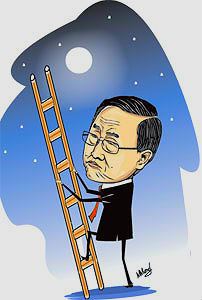
You thought to scale Heav’n’s lofty Wall
by Ladders of your own.