Hindoo Folk Song

 तत् त्वम् असि 

for sitar, mridangam, vina, musical spoons, washboard, Jew’s harp and banjo
 (the names Swami and Guru-ji can be replaced by
any other mystic names the reader wishes to substitute)

Swami and Guru-ji went to the river

to wash their souls in the dirty water
filled brass pots while they were at it, singing:

“These are Gods—
worship them, worship them,

these are Gods—
won’t you worship them please”

Guru and Swami-ji flexed contortions
twisted minds and limbs in knots
sold each other secret mantras
to erase akashic records when the body rots

Swami and Guru-ji taught disciples
how to fast and hum and chant;
bound their loins with priestly garments, saying

“These are Gods—worship them, worship them,
these are Gods—won’t you worship them please”

Guru and Swami-ji swallowed prana
purged their guts, then farted light
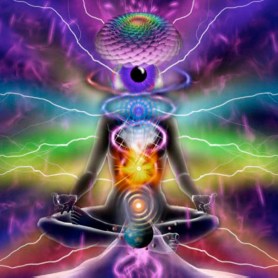
launched their chakras into oneness
in the ida and pingala of their third-eye sight

Swami and Guru-ji built a temple
around a monstrous calf of gold
bowed before the six-armed idols chanting

“These are Gods—
worship them, worship them,

these are Gods—
won’t you worship them please”

Guru and Swami-ji studied parchments
by the dim light of a feeble ray
railed and wailed at the sinful  heathen
in the filthy Kali-yuga of the dying day

Swami and Guru-ji made ablutions
offered incense and holy foods
ate their share and smoked the profit, humming

“These are Gods—worship them, worship them,
these are Gods—won’t you worship them please”

Guru and Swami’s blissed devotions
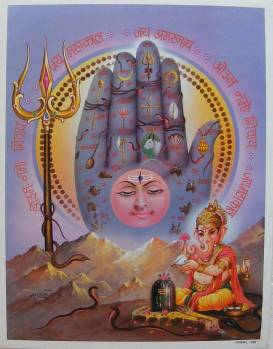
entwined their members with the temple belles;
stuck their yonis up their lingams
in the twenty-seventh circle of the seven hells.

Swami and Guru-ji offered puja
wrote it all off as a karmic debt—
forced a shudra to bear the burden, screaming

“These are Gods—
worship them, worship them,

these are Gods—
won’t you worship them please”

Guru and Swami-ji meditated:
pure omniscience in eternal now;
drank fresh urine from a heifer’s  bladder
for they knew that it was soma from a holy cow.

Swami and the Guru merged with Brahman
then went home to the wife and kids.
Told the servants to polish statues, saying

“These are Gods—worship them, worship them,
these are Gods – won’t you worship them please”


THE MORAL:
slower solemn rhythm, no banjo or Jew’s harp

 Aaron’s calf is ground to powder,
cast upon the Ganges’ tide.
Every tribe shall taste its poison.

 “This is God—worship Him, worship Him –
this is God—let us worship Him now…”

Armed and Dubious

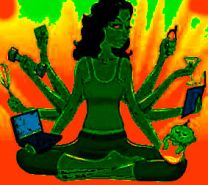
six-armed-blue-meanie   selfish-idol-e1380164258279
to the esteemed B.J.P

Six-armed things of Asiatic trances,
temple belles entwined in temple dances:
mantra in one hand, the other holds naan.
One holding chutney and the other, paan.
Two hands left (befitting of deity):
one offers curry, one incense.  Aseity
signifies self-contented wonderment.
(One wonders as well what that mantra meant…)

Note the third eye in the figure’s forehead:
a spare one in case left or right go dead?
But really—how freakish these idols look:
a psycho-pantheon from a nightmare book.
(Outdone only by the Aztecs for fright
along with demons born of tribal night.)

Cobra-crowned elephant-headed mutants
sickly-sweet incense, divine pollutants
mix in with the stench of bodies burning
alongside the filthy Ganges churning
flowing with ashes from funeral ghats 
excrement, corpses of humans and rats
that swarmed humble hovels of Hindustan
where gods are mass-produced for fallen man.

Maidens in saris with red tinted lips;
glossy vulgarity, loose at the hips
now growing more arms; an insect vision
enough to make one gag on religion.

The ubiquitous trident looms, a sign:
the eternally present un-divine.
Instead, it ought to stick some sacred cow
in its bovine buttocks, and so allow
beef curry for a hungry avatar
craving fresh meat in his juggernaut car.

Turn from this antediluvian scene
in sincerity, ask: what does it mean?
Were you created in these gods’ image?
Is anything real behind their visage?
Blue skin and sick smiles, anointed with ghee:
exotic . . . but wrong theologically.
Till lingams are yonis I’ll spell it out;
these Aryan idols should merit your doubt.
Such weirdness deserves some analysis
(as did old Diana of Ephesus).

Would you tingle if such a god showed up
and offered to refill your soma cup,
sending siddhis up your spinal column
with you in full lotus, clueless, solemn.
Would you offer puja in their temple,
bedeck your soul in a robe to sample
veggie-masalas, chapatis and dal,
peruse the Upanishads, and enthrall
your mind with the mystic old Rig-Vedas
fall for idolatrous sin conveyed
as spiritual truth when it’s just a big lie…
bow before a multi-armed freak?  Not I.
Not for all the visions in Satan’s world.
Better to call B.S. than to be hurled
to hell for living and loving this lie
embracing monstrosities. By and by
the books will be opened. The Lord will judge.
C
onsider this your transcendental nudge
toward something less false, less fearfully fake
than the idols Antichrist nations make.

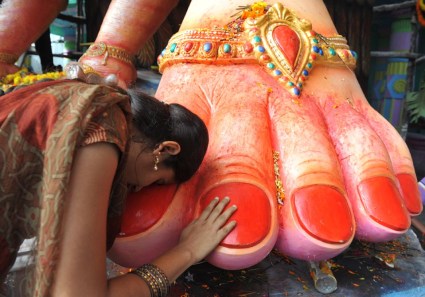
idols-toe

 
IMAGE CREDITS: Harry Fokker
nationalgeographic.com
trustingortripping.wordpress.com


Yoga-Yuga


Kali Yuga (Sanskrit: कलियुग, translit. kaliyuga, lit. ‘age of Kali’) is the last of the four stages (or ages or yugas) the world goes through as part of a ‘cycle of yugas’ (i.e. Mahayuga) described in the Sanskrit scriptures. The other ages are called Satya Yuga, Treta Yuga, and Dvapara Yuga.

Kali Yuga is associated with the demon Kali (not to be confused with the goddess Kālī). The “Kali” of Kali Yuga means “strife”, “discord”, “quarrel” or “contention”.

(from Wikipedia)


Whittier was Prettier


The Over-Heart

John Greenleaf Whittier (1807–1892)

  “For of Him, and through Him, and to Him are all things,
to whom be glory forever.” — PAUL.

ABOVE, below, in sky and sod
In leaf and spar, in star and man,
Well might the wise Athenian scan
The geometric signs of God,
The measured order of His plan.

And India’s mystics sang aright
Of the One Life pervading all,—
One Being’s tidal rise and fall
In soul and form, in sound and sight,—
Eternal outflow and recall.

God is: and man in guilt and fear
The central fact of Nature owns;
Kneels, trembling, by his altar-stones,
And darkly dreams the ghastly smear
Of blood appeases and atones.

Guilt shapes the Terror: deep within
The human heart the secret lies
Of all the hideous deities;
And, painted on a ground of sin,
The fabled gods of torment rise!

And what is He? The ripe grain nods,
The sweet dews fall, the sweet flowers blow;
But darker signs His presence show:
The earthquake and the storm are God’s,
And good and evil interflow.

O hearts of love! O souls that turn
Like sunflowers to the pure and best!
To you the truth is manifest:
For they the mind of Christ discern
Who lean like John upon His breast!

In him of whom the sibyl told,
For whom the prophet’s harp was toned,
Whose need the sage and magian owned,
The loving heart of God behold,
The hope for which the ages groaned!

Fade, pomp of dreadful imagery
Wherewith mankind have deified
Their hate, and selfishness, and pride!
Let the scared dreamer wake to see
The Christ of Nazareth at his side!

What doth that holy Guide require?
No rite of pain, nor gift of blood,
But man a kindly brotherhood,
Looking, where duty is desire,
To Him, the beautiful and good.

Gone be the faithlessness of fear,
And let the pitying heaven’s sweet rain
Wash out the altar’s bloody stain;
The law of Hatred disappear,
The law of Love alone remain.

How fall the idols false and grim!
And lo! their hideous wreck above
The emblems of the Lamb and Dove!
Man turns from God, not God from him;
And guilt, in suffering, whispers Love!

The world sits at the feet of Christ,
Unknowing, blind, and unconsoled;
It yet shall touch His garment’s fold,
And feel the heavenly Alchemist
Transform its very dust to gold.

The theme befitting angel tongues
Beyond a mortal’s scope has grown.
O heart of mine! with reverence own
The fulness which to it belongs,
And trust the unknown for the known.

  1859