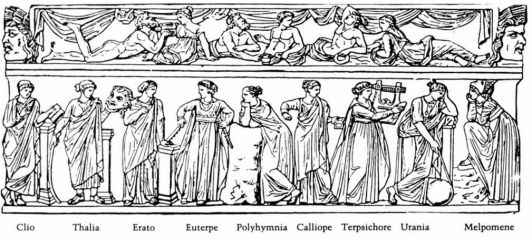
Be Mused Today

To My Muse

Jane Turell (1708–1735)

COME, gentle muse, and once more lend thine aid,

O bring thy succor to a humble maid!

How often dost thou liberally dispense

To our dull breast thy quick’ning influence!

By thee inspired, I’ll cheerful tune my voice,

And love and sacred friendship make my choice.

In my pleased bosom you can freely pour,

A greater treasure than Jove’s golden shower.

Come now, fair muse, and fill my empty mind,

With rich ideas, great and unconfin’d.

Instruct me in those secret arts that lie

Unseen to all but to a poet’s eye.

O let me burn with Sappho’s noble fire,

But not like her for faithless man expire.

And let me rival great Orinda’s fame,

Or like sweet Philomela’s be my name.

Go lead the way, my muse, nor must you stop

Till we have gain’d Parnassus’ shady top:

Till I have view’d those fragrant soft retreats,

Those fields of bliss, the muses’ sacred seats.

I’ll then devote thee to fair virtue’s fame,

And so be worthy of a poet’s name.
 

Discovered in Bartleby’s goldmine

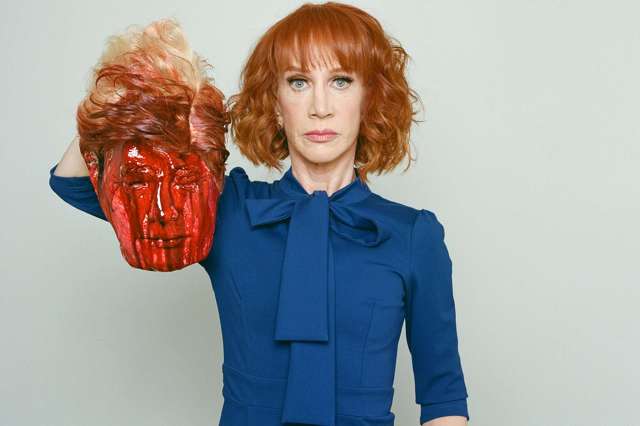
Kathy Axes a Bloody Question

He nothing common did or mean
Upon that memorable scene,
But with his keener eye
The axe’s edge did try;

Nor call’d the gods with vulgar spite
To vindicate his helpless right,
But bowed his comely head
Down as upon a bed.

This was that memorable hour
Which first assur’d the forced pow’r.
So when they did design
The Capitol’s first line,

A bleeding head, where they begun,
Did fright the architects to run;
And yet in that the state
Foresaw its happy fate.

from: An Horatian Ode upon Cromwell’s Return from Ireland
By Andrew Marvell (1621–1678)

Impelled toward a Momentary Regularity

Emerson’s remark helps suggest the all-important difference: “It is not meters, but a meter-making argument that makes a poem.” In this kind of poem the poet establishes regularity only to depart from it expressively. When he does compose a metrically regular line it is not because the metrical scheme tells him to, but because something in the matter he is embodying impels him toward a momentary regularity.   […] 

The poet working in free verse has already chosen to eschew one of the the most basic expressive techniques in poetry.

Paul Fussell: Poetic Meter and Poetic Form
(from Chapter 3, Metrical Variations)

Why is poetry dead?

Because the combination of song writer and recorded music displaced it. A song is much more accessible to the average person than a poem, and technology made songs widely available. Poetry responded to its diminished status by retreating into narcissistic incoherence. Sure the philistines may not recognize the true greatness of modern poetry, but at least poets could take comfort in their own self-declared cultural superiority. When public rejection became a necessary characteristic of great poetry, then there was no longer any hope.

It’s not correct to say a poet is the same as a song writer. It’s easier to write lyrics for a song because the song writer can lean upon the music. The poet has only words (and at one time such archaic concepts as rhyme and rhythm and meaning and significant subject matter) to carry his message. Poetry is a much harder art form. But better Dylan than a modern poet who composes what passes for poetry in this day and age. Better to let the dead decompose undisturbed.

commentary by Carl Jacobs at The Spectator