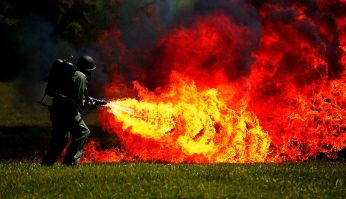
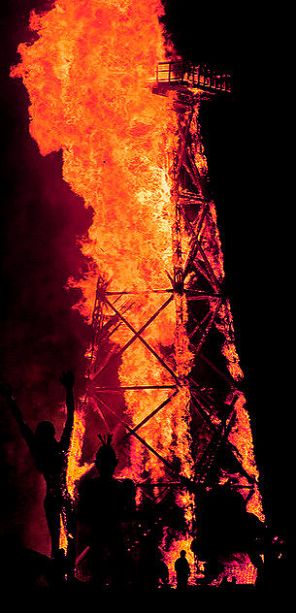
Haunted by data, hounded by blog-bots, assailed by algorithms, poets have been reduced to human resources, fractionated, monetized and commodified like petrochemical residues of the antediluvian world. In keeping with that metaphor imposed upon us by ourselves, we await a mere spark to begin consuming our own fuel, flaming voraciously into poetic combustion. Through this incendiary process, we liberate the very energy that an unpoetic world seeks to label, quantify and merchandize. Flame, however, cannot be commodified—only intensified, suppressed, or extinguished. Elemental fire may be started by lightning, produced by physical friction, electro-chemical reaction, or started from a pre-existing blaze. Poetry is similar; whether sent from God as a bolt of epiphany, a spontaneous combustion, or as a transposed flame inspired by anterior works, April is our month for playing with metaphysical fire. It is thus that we, as elemental (or just mental) poets, refuse, at all levels (lyrical, cultural, mercantile, geologic, celestial and infernal, etc.) to be co-opted, commodified, and/or in any way politically corrected.
We poetic oilmen and women are the active nihilists of a nihilistic era. We locate promising sites, then we draw up, from below poetic bedrock, raw inspiration. NaPoWriMo allows us to drill deep into the sedimentary layers of poetry and tap into the deposits of lyrical fuel trapped within. Some gets pumped up, some comes gushing spontaneously to the surface in a crude form. It can then be refined to varying degrees of flammability and into differing types of fuel; think diesel versus jet fuel… one will take you further faster, but both are indeed fuel.
As oilmen and women, we pump our precious resource up in raw form from subterranean seas—the remains of lyric flora and fauna of a previous age buried under the silt of an inundation of data-driven global dullness. Through sheer creative will we set these deposits ablaze, to produce, out of the incoherent night that surrounds us, poetic illumination. In the light of our own flame, we cerebratecelebrate the utter uselessness of our artistic product—by continuing to create it, refine it, and then burn it up in a transcendent pyre of irrelevance. Thus, we wage uncompromising war against the powers and principalities of technoid global dominion. Our useless words, unread and unwanted, undermine the process of attempted global conquest by the unpoetic Enemy.
How and why do I love The Vicar of Bray? Let me count the ways.
First, we have that intriguing author. No mythic background, no poetic baggage associated with the name: Anonymous. The interest and the significance must come purely through the reading and the understanding of it. This brings us to the actual content of the poem, its message. The Vicar only pays out his jackpot to Anglophiles who know something about England’s political and ecclesiastical history. It is not for everyone; I can’t imagine a non-Anglophile getting much out of this poem. But the catalyst for me (ha ha) is the absurd image of the poor feline being basted in an oven. I don’t know if it was a popular idiom of the day, but I found it arresting and absurdly hilarious all at once. And of course there is the rollicking and regular rhythm, complemented by the recurring refrain. Was it a song originally rather than mere verse ? Probably.
In good King Charles’s golden days,
When Loyalty no harm meant;
A Furious High-Church man I was,
And so I gain’d Preferment.
Unto my Flock I daily Preached,
Kings are by God appointed,
And Damn’d are those who dare resist,
Or touch the Lord’s Anointed.
And this is law, I will maintain Unto my Dying Day, Sir. That whatsoever King may reign, I shall be Vicar of Bray, Sir!
When Royal James possessed the crown,
And popery grew in fashion;
The Penal Law I hooted down,
And read the Declaration:
The Church of Rome I found would fit
Full well my Constitution,
And I had been a Jesuit,
But for the Revolution.
And this is Law, &c.
When William our Deliverer came,
To heal the Nation’s Grievance,
I turned the Cat in Pan again,
And swore to him Allegiance:
Old Principles I did revoke,
Set conscience at a distance,
Passive Obedience is a Joke,
A Jest is non-resistance.
And this is Law, &c.
When Royal Ann became our Queen,
Then Church of England’s Glory,
Another face of things was seen,
And I became a Tory:
Occasional Conformists base
I Damn’d, and Moderation,
And thought the Church in danger was,
From such Prevarication.
And this is Law, &c.
When George in Pudding time came o’er,
And Moderate Men looked big, Sir,
My Principles I changed once more,
And so became a Whig, Sir.
And thus Preferment I procured,
From our Faith’s great Defender,
And almost every day abjur’d
The Pope, and the Pretender.
And this is Law, &c.
The Illustrious House of Hanover,
And Protestant succession,
To these I lustily will swear,
Whilst they can keep possession:
For in my Faith, and Loyalty,
I never once will falter,
But George, my lawful king shall be,
Except the Times should alter.


 Haunted by data,