The Columbiad Survives

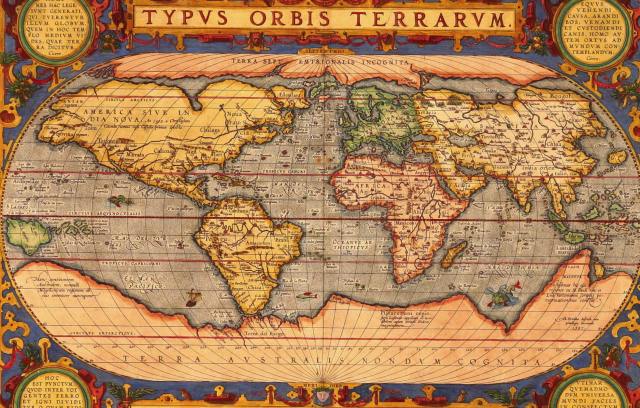
Le monde

The Columbiad, in its present form, is such as I shall probably leave it to its fate. Whether it be destined to survive its author, is a question that gives me no other concern than what arises from the most pure and ardent desire of doing good to my country. To my country therefore, with every sentiment of veneration and affection I dedicate my labors.

Joel Barlow from PREFACE 1809

My object is altogether of a moral and political nature I wish to encourage and strengthen in the rising generation, a sense of the importance of republican institutions; as being the great foundation of public and private happiness, the necessary aliment of future and permanent ameliorations in the condition of human nature.

This is the moment in America to give such a direction to poetry, painting and the other fine arts, that true and useful ideas of glory may be implanted in the minds of men here, to take place of the false and destructive ones that have degraded the species in other countries; impressions which have become so wrought into their most sacred institutions, that it is there thought impious to detect them and dangerous to root them out, tho acknowledged to be false. Woe be to the republican principle and to all the institutions it supports, when once the pernicious doctrine of the holiness of error shall creep into the creed of our schools and distort the intellect of our citizens!

Joel Barlow from PREFACE 1809

I sing the Mariner who first unfurl’d
An eastern banner o’er the western world,
And taught mankind where future empires lay
In these fair confines of descending day;
Who sway’d a moment, with vicarious power,
Iberia’s sceptre on the new found shore,
Then saw the paths his virtuous steps had trod
Pursued by avarice and defiled with blood,
The tribes he foster’d with paternal toil
Snatch’d from his hand, and slaughter’d for their spoil.

Slaves, kings, adventurers, envious of his name,
Enjoy’d his labours and purloin’d his fame,
And gave the Viceroy, from his high seat hurl’d.
Chains for a crown, a prison for a world
Long overwhelm’d in woes, and sickening there,
He met the slow still march of black despair,
Sought the last refuge from his hopeless doom,
And wish’d from thankless men a peaceful tomb:
Till vision’d ages, opening on his eyes,
Cheer’d his sad soul, and bade new nations rise;
He saw the Atlantic heaven with light o’ercast,
And Freedom crown his glorious work at last.

Almighty Freedom! give my venturous song
The force, the charm that to thy voice belong;
Tis thine to shape my course, to light my way,
To nerve my country with the patriot lay,
To teach all men where all their interest lies,
How rulers may be just and nations wise:
Strong in thy strength I bend no suppliant knee,
Invoke no miracle, no Muse but thee.
Joel Barlow: The Columbiad  (1809)

The Columbiad (pt 1)


Le mondeEvery circumstance relating to the discovery and settlement of America is an interesting object of inquiry, especially to the great and growing nations of this hemisphere, who owe their existence to those arduous labors. Yet it is presumed that many persons, who might be entertained with a poem on this subject, are but slightly acquainted with the life and character of the hero whose extraordinary genius led him to discover the continent, and whose singular sufferings, arising from that service, ought to excite the indignation of the world.

Christopher Columbus was born in Genoa about the year 1447, when the navigation of Europe was scarcely extended beyond the limits of the Mediterranean and the other narrow seas that border the great ocean. The mariner’s compass had been invented and in common use for more than a century; yet with the help of this sure guide, and prompted by a laudable spirit of discovery, the mariners of those days rarely ventured from the sight of land.

(from the Introduction)

Joel Barlow: The Columbiad  (1809)


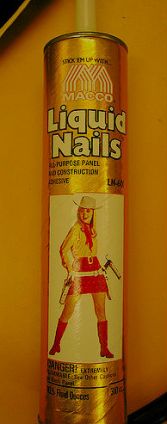
Ode to a Caulk Gun

NaPoWriMo prompt: a poem that takes the form of a warning label

STICK’EM UP
with LIQUID NAILS

DANGER ! EXTREMELY FLAMMABLE
See Other Caution on Back Panel:

I’m hot for you Cowgirl. You’re so flammable my glue-gun starts to melt; my screwdriver starts twisting when you loosen that low-slung belt. You make me feel like laying re-bar in a freshly-poured foundation. Shoot me up with that caulk gun baby—I need you like salvation. Ten and one-half fluid ounces—pull off your top, pop a love-cap in me. Fingerin’ your trigger while the job is gettin’ bigger so take me for a ride to the hardware store, honey, cause I’m seeing red and feeling white on your golden background’s sheer delight.  Hammer me a heart-full, spike me on a cross of blonde, I’m hanging ten, surfing the tube of your magic wand. I’ve been in love ever since I first waterproofed my seamy undersides with you . . . stand over me in those red, red boots, you Liquid Nails Girl—and from your pure white Stetson let righteousness unfurl. You won the shoot-out long before you even drew, my dear. Lost hope of the Wild West, Final Frontal Feminine Frontier—there’s only one side of you . . . your GOOD side.  Just one look and your fearless gaze silences the foes, my blooming prairie rose.
YEE-HAW !  Be my angel, be my dream, my valentine rodeo queen, be my bodyguard, my therapist, long & tall & hard & wet—be my Liquid Nails Girl forever and I’ll ride right into your sunset . . .

NEXT IDEA: the Land O’ Lakes Squaw . . .

IMAGE CREDIT:  radargeek @ flickriver.com

Marching Over Poets’ Graves

I am re-posting previous work during March.
Since 2014, I’ve published 30 original poems
for National Poetry Writing Month every April.

You can read more by clicking the NaPoWriMo widgets to the right


8-american-poets

 Verse  on  the  Rocks

Cryptography prior to the modern age
was effectively synonymous with encryption,

the conversion of information from a readable state
to apparent nonsense.
Wikipedia: Cryptography

Berryman, Bishop, Plath, Sexton, et al
(whose verse preserves badly in alcohol)
distilled tepid poems full half-throttle:
Not-so-wild turkeys, jiggling their wattle.

I strive in vain to uncover meaning
though such dry fields are barely worth gleaning;
pompous hackademics of brave new verse
have shown, through their scrawling, it can get worse;
wordsmiths of dullness for grad students’ gain,
grant scholars trading in pleasure for pain
with each odd word choice or wretched refrain.

Berryman, Bishop, Lowell, Sexton and Plath
prepare me for rest in their tepid bath
as I try to read them—but fall asleep
the book upon my breast, my boredom deep.
A soporific tried and true, such dreck.
(Amazing they could even cash a check.)

Did madness excuse them to make a fuss,
force meaningful discourse to languish thus
in obfuscation and cryptography
submerged in rarefied verbosity?
What frumpy muse, nose in her thesaurus
hoped to, this scholarly way, implore us
while putting on airs un-deliriously
to study such silly screeds seriously?

Berryman, Bishop, Plath, Sexton, and Lowell
lured me with poetry into their hole.
Lord, how these clowns made a good thing boring;
they should have set earthbound souls to soaring.
but turned it into a master’s thesis,
fracturing verse to erudite pieces.

Berryman, overrated mass of sheer
vocabulary overload, unclear,
seems more to justify modernist doubt
than to show what real poetry’s about.

Bishop, cryptic identity-monger
(America’s Vassar-girl no longer)
wrote vaguely accessible verse, sometimes . . .
and some of her poetry even rhymes!

Plath, prima donna, boring semantics
failing to compensate for her antics
blathering bitterness, head in oven
might have been happier joining a coven.

Sexton, pill-headed prophetess unchained
half poetess of half-sense, half-brained
departed with zest,  from her own garage.
(We’re still decoding her cryptic barrage).

Lowell, left quaking in his unstoned grave
more interesting—but still a verbose knave.

These self-absorbed nerds, when not at their shrink
checked out in adultery, pills and drink.
Such sad celebrants of depraved excess,
no vanguard at all, are more a regress
to endless jaded pointlessness and dope,
their abstract verbiage void of all hope.

Who canonized these unexploded shells,
these duds, these fizzling scribes of milquetoast hells . . .
must we hail and applaud such labored lines?
Instead, make them pay some posthumous fines!
They withered awhile, these funereal blooms;
let REAL poets turn over in their tombs;
call spades on what my ringing spade exhumes.

Cream of lyric America. I yawn.
It’s late now. White moonlight exalts the lawn.
The world sleeps on, lulled to death by dull verse
May their ghosts, fully exorcised, disperse . . .


Post-modern oceans:
poetry now lost at sea.
Muse overboard! (retch)