Unpoetic Americans Draining Swamps

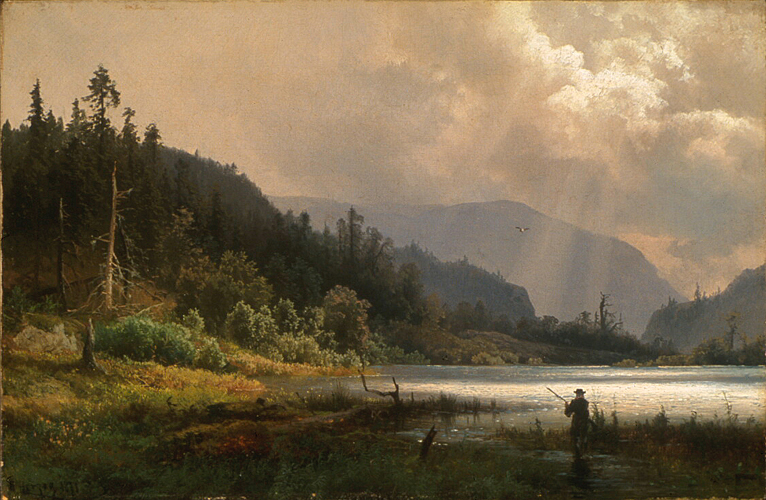
I readily admit that the Americans have no poets; I cannot allow that they have no poetic ideas. In Europe people talk a great deal of the wilds of America, but the Americans themselves never think about them; they are insensible to the wonders of inanimate nature and they may be said not to perceive the mighty forests that surround them till they fall beneath the hatchet. Their eyes are fixed upon another sight: the American people views its own march across these wilds, draining swamps, turning the course of rivers, peopling solitudes, and subduing nature. This magnificent image of themselves does not meet the gaze of the Americans at intervals only; it may be said to haunt every one of them in his least as well as in his most important actions and to be always flitting before his mind.

Nothing conceivable is so petty, so insipid, so crowded with paltry interests–in one word, so anti-poetic–as the life of a man in the United States. But among the thoughts which it suggests, there is always one that is full of poetry, and this is the hidden nerve which gives vigor to the whole frame.
https://www.newpaltz.edu/media/museum/exhibitions/american-scenery/webslides/herzog_manhunting.jpg
Of Some Sources of Poetry Among Democratic Nations

Alexis De Tocqueville: Democracy in America, published 1835–1840

Democratic Poets Exercise Powers

As all the citizens who compose a democratic community are nearly equal and alike, the poet cannot dwell upon any one of them; but the nation itself invites the exercise of his powers. The general similitude of individuals, which renders any one of them taken separately an improper subject of poetry, allows poets to include them all in the same imagery and to take a general survey of the people itself. Democratic nations have a clearer perception than any others of their own aspect; and an aspect so imposing is admirably fitted to the delineation of the ideal.


Of Some Sources of Poetry Among Democratic Nations
Alexis De Tocqueville: Democracy in America, published 1835–1840


Poetry: Haunted by the Future

I am persuaded that in the end democracy diverts the imagination from all that is external to man and fixes it on man alone. Democratic nations may amuse themselves for a while with considering the productions of nature, but they are excited in reality only by a survey of themselves. Here, and here alone, the true sources of poetry among such nations are to be found; and it may be believed that the poets who neglect to draw their inspirations hence will lose all sway over the minds which they would enchant, and will be left in the end with none but unimpassioned spectators of their transports.

I have shown how the ideas of progress and of the indefinite perfectibility of the human race belong to democratic ages. Democratic nations care but little for what has been, but they are haunted by visions of what will be; in this direction their unbounded imagination grows and dilates beyond all measure. Here, then, is the widest range open to the genius of poets, which allows them to remove their performances to a sufficient distance from the eye. Democracy, which shuts the past against the poet, opens the future before him.


Of Some Sources of Poetry Among Democratic Nations

Alexis De Tocqueville: Democracy in America, published 1835–1840

Springs of Poetry Go Dry

In democratic communities, where men are all insignificant and very much alike, each man instantly sees all his fellows when he surveys himself. The poets of democratic ages, therefore, can never take any man in particular as the subject of a piece; for an object of slender importance, which is distinctly seen on all sides, will never lend itself to an ideal conception.

Thus the principle of equality, in proportion as it has established itself in the world, has dried up most of the old springs of poetry. Let us now attempt to see what new ones it may disclose.

When skepticism had depopulated heaven, and the progress of equality had reduced each individual to smaller and better-known proportions, the poets, not yet aware of what they could substitute for the great themes that were departing together with the aristocracy, turned their eyes to inanimate nature. As they lost sight of gods and heroes, they set themselves to describe streams and mountains. Thence originated, in the last century, that kind of poetry which has been called, by way of distinction, descriptive. Some have thought that this embellished delineation of all the physical and inanimate objects which cover the earth was the kind of poetry peculiar to democratic ages; but I believe this to be an error, and that it belongs only to a period of transition.

Of Some Sources of Poetry Among Democratic Nations

Alexis De Tocqueville: Democracy in America, published 1835–1840