ψ The Multitudinous Abyss ψ

I’m STILL on an Atlantean roll, like lobster salad – or a deep-fried clam.
(See previous 2 posts)
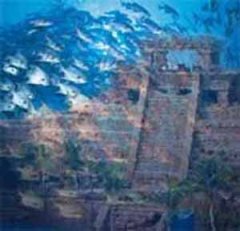
I am lost in submerged speculation –
rapt in the deeps of contemplation where I view the ruined civilizations of man…
I want to know what happened exactly.
I want to know it all.
I long for wisdom.  Do you?

 
The word of God has this to say in Job 28:

But where shall wisdom be found? and where is the place of understanding?
Man knoweth not the price thereof; neither is it found in the land of the living.
The depth saith, It is not in me: and the sea saith, It is not with me.
It cannot be gotten for gold, neither shall silver be weighed for the price thereof.
It cannot be valued with the gold of Ophir, with the precious onyx, or the sapphire.
The gold and the crystal cannot equal it:
and the exchange of it shall not be for jewels of fine gold.
No mention shall be made of coral, or of pearls: for the price of wisdom is above rubies.
The topaz of Ethiopia shall not equal it, neither shall it be valued with pure gold.

Whence then cometh wisdom? and where is the place of understanding?
Seeing it is hid from the eyes of all living, and kept close from the fowls of the air.
Destruction and death say, We have heard the fame thereof with our ears.
God understandeth the way thereof, and he knoweth the place thereof.
For he looketh to the ends of the earth, and seeth under the whole heaven;
To make the weight for the winds; and he weigheth the waters by measure.
When he made a decree for the rain, and a way for the lightning of the thunder:
Then did he see it, and declare it; he prepared it, yea, and searched it out.
And unto man he said, Behold, the fear of the Lord, that is wisdom;
and to depart from evil is understanding.

(And if you don’t love the King James Version
you can  go to hell read it in another translation.)

I believe the following poet had Atlantean wisdom. Perhaps you will agree.
Here is a beautiful part of Christopher Smart’s epic Song to David:

He sang of God—the mighty source
Of all things—the stupendous force
   On which all strength depends;
From whose right arm, beneath whose eyes,
All period, power, and enterprise
   Commences, reigns, and ends.    

Angels—their ministry and meed,
Which to and fro with blessings speed,
   Or with their citterns wait;
Where Michael, with his millions, bows,
Where dwells the seraph and his spouse,
   The cherub and her mate.

Of man—the semblance and effect

Of God and love—the saint elect
   For infinite applause—
To rule the land, and briny broad,
To be laborious in his laud,
   And heroes in his cause.
  
The world, the clustering spheres, He made;    
The glorious light, the soothing shade,   
   Dale, champaign, grove, and hill;   
The multitudinous abyss,   
Where Secrecy remains in bliss,   
   And Wisdom hides her skill.

The pillars of the Lord are seven,
Which stand from earth to topmost heaven;
   His Wisdom drew the plan;
His Word accomplish’d the design,
From brightest gem to deepest mine;
From Christ enthroned, to Man… 
This poem is amazing.
It just rolls on and on, touching on so many diverse subjects, like a peal of  lyrical thunder.
I recommend reading the entire thing, out loud if possible.
Until we meet again in that fair land above the Atlantean depths, stay POETIC.

I’m Lovin’ his Craft

I just can’t kick this Atlantean thing.
It’s TOO fascinating.  I scanned through Gavin Menzies book yesterday…
even more interesting since I was lucky enough
to visit both Crete and the island of Thera in 1982.
Those Bronze-age explorers certainly got around.
I will post the one-hour video his Atlantis site is linked to for you very soon.
And now I offer you one of my favorite Atlantean passages :
[from: The Temple,  by H.P. Lovecraft]

…What I saw was an extended and elaborate array of ruined edifices; all of magnificent though unclassified architecture, and in various stages of preservation. Most appeared to be of marble, gleaming whitely in the rays of the searchlight, and the general plan was of a large city at the bottom of a narrow valley, with numerous isolated temples and villas on the steep slopes above. Roofs were fallen and columns were broken, but there still remained an air of immemorially ancient splendour which nothing could efface.
Confronted at last with the Atlantis I had formerly deemed largely a myth, I was the most eager of explorers. At the bottom of that valley a river once had flowed; for as I examined the scene more closely I beheld the remains of stone and marble bridges and sea-walls, and terraces and embankments once verdant and beautiful. In my enthusiasm I became nearly as idiotic and sentimental as poor Klenze, and was very tardy in noticing that the southward current had ceased at last, allowing the U-29 to settle slowly down upon the sunken city as an aëroplane settles upon a town of the upper earth. I was slow, too, in realizing that the school of unusual dolphins had vanished.
In about two hours the boat rested in a paved plaza close to the rocky wall of the valley. On one side I could view the entire city as it sloped from the plaza down to the old river-bank; on the other side, in startling proximity, I was confronted by the richly ornate and perfectly preserved facade of a great building, evidently a temple, hollowed from the solid rock. Of the original workmanship of this titanic thing I can only make conjectures. The facade, of immense magnitude, apparently covers a continuous hollow recess; for its windows are many and widely distributed. In the centre yawns a great open door, reached by an impressive flight of steps, and surrounded by exquisite carvings like the figures of Bacchanals in relief. Foremost of all are the great columns and frieze, both decorated with sculptures of inexpressible beauty; obviously portraying idealised pastoral scenes and processions of priests and priestesses bearing strange ceremonial devices in adoration of a radiant god. The art is of the most phenomenal perfection, largely Hellenic in idea, yet strangely individual. It imparts an impression of terrible antiquity, as though it were the remotest rather than the immediate ancestor of Greek art. Nor can I doubt that every detail of this massive product was fashioned from the virgin hillside rock of our planet. It is palpably a part of the valley wall, though how the vast interior was ever excavated I cannot imagine. Perhaps a cavern or series of caverns furnished the nucleus. Neither age nor submersion has corroded the pristine grandeur of this awful fane—for fane indeed it must be—and today after thousands of years it rests untarnished and inviolate in the endless night and silence of an ocean chasm.
I cannot reckon the number of hours I spent in gazing at the sunken city with its buildings, arches, statues, and bridges, and the colossal temple with its beauty and mystery. Though I knew that death was near, my curiosity was consuming; and I threw the searchlight’s beam about in eager quest. The shaft of light permitted me to learn many details, but refused to shew anything within the gaping door of the rock-hewn temple; and after a time I turned off the current, conscious of the need of conserving power.

Beneath the Waves Without a Trace

Today’s post explores a theme of perennial interest to me  –
and perhaps a topic of ridicule for those outside the submarine circle,
ATLANTIS: the Lost Continent.

Why does the legend of the sunken civilization resonate so strongly with some of us?
For me, it has a powerful subconscious undertow.

It must be because at a subliminal level we know it speaks about our current civilization. We read portents of our impending doom into the connections (actual as well as delusional) that we trace throughout previous epochs and civilizations. It is an eternal parable of edenic perfection and good government in an idyllic golden age which, through hubris, degenerated into a corrupt and fallen civilization that was destroyed in a sudden well-deserved cataclysm.

Other nut-cases and archeo-illogical dreamers have lit the watery way for us, beginning with Plato,  from Ignatius Donnelly and the French madman Antonin Artaud, to Edgar Cayce and H.P. Lovecraft.

Atlantis has fascinated me since I was young—but I became especially obsessed with the legend during my time immersed (submerged?) in the New Age/Occult. I was first made aware of its disturbing psychic implications in The Peyote Dance: A Voyage to the Land of the Tarahumaras by Artaud.

There are cases to be made for Thera/Santorini as the center of the maritime empire (Gavin Menzies even puts forth a theory of Minoan  interaction with bronze-age Meso-American cultures) but I am particularly interested in the Yucatan/Caribbean strands of Atlantis lore (as was Lovecraft, who placed the sunken city off the Yucatan in his epic tale The Temple), which seems to be corroborated by topographical anomalies off the southern Cuban coast.
The Bermuda Triangle hypothesis is likewise presented in this fantastic book for the chosen few: The Bible and the Bermuda Triangle.

Here is a poem I wrote in the late 1980’s about the subject.
It was inspired by an illustration from a 1950’s Time/Life history book by Alton Tobey

Aztlan

The Aztecs also claimed to have come originally from Aztlan…
Their very name, Aztecs, was derived from Aztlan.
[Bancroft’s Native Races, vol. V]

 Atlantis is rising, the sin unforgiven
by blood from the hearts which the idols were given.
Aquarian nexus of mystic tradition:
pre-Maya, pre-Toltec, Aztlan: the Origin.

Their temples were glimpsed in infernal damnation
The images carved in symmetrical vision
Where evil, unbounded, uncovers its visage
and flows down the axis of false revelation.

Copal on the steps of the temples was wafting
their censers were smoking, the mirrors were flashing
The crystalline rites of a land in submergence
remembered in priestly obsidian slashing.

But even as life was subsiding from victims
whose blood caught the sunlight with crimson reflection
the vengeance awaited in green vegetation
to swiftly re-conquer an ossified nation.

The sea has her secret Sargassoes of culture,
her tides and abysses of suction and quaking.
Volcanic displacements cause sudden reversals
where continents vanish with new lands awaking.

Thus history finally disposes of those
who refuse to attune to the warning instruction.
They sink in a fit of deluded ambition
denying their part in divine evolution.

Now current-borne memories glide through the temples
where cruelty flourished, oppressing the blameless.
When submarine fable turns modern example
all powers, all titles, prove hollow and nameless.

Atlantis is rising, the debt unforgiven
And straight to the throne of the judgement is driven.
Aquarian idol of mystic tradition:
pre-Olmec, pre-Toltec, Aztlan:  the revision –

revealed in the end as the Israelite’s error
when Baal was enshrined and the rule was by terror.

THIS JUST IN:  Atlantis in the Andes !!!