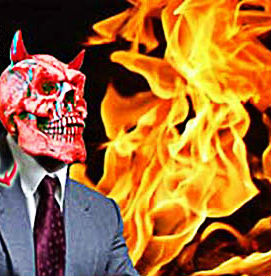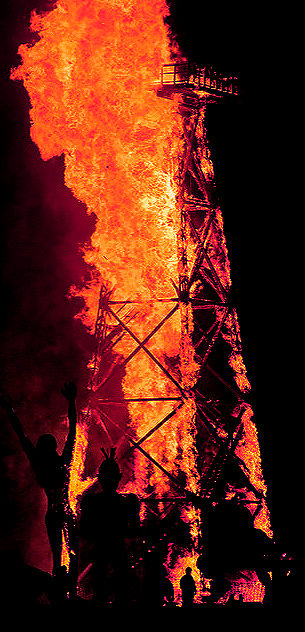
Burning Hell: Doom

Michael Wigglesworth (1631—1705)
It is put in Execution.

CCVI.

That word “Depart,” maugre their heart,
drives every wicked one,
With mighty pow’r, the self-same hour,
far from the Judge’s Throne.
Away they’re chas’d by the strong blast
of his Death-threat’ning mouth;
They flee full fast, as if in haste,
although they be full loath.

CCVII.

As chaff that’s dry, as dust doth fly
before the Northern wind.
Right so are they chaséd away,
and can no Refuge find.
They hasten to the Pit of Woe,
guarded by Angels stout.
Who to fulfil Christ’s holy Will,
attend this wickéd Rout;

HELL.

CCVIII.

Whom having brought as they are taught,
unto the brink of Hell,
(That dismal place, far from Christ’s face,
where Death and Darkness dwell,
Where God’s fierce Ire kindleth the fire,
and vengeance feeds the flame.
With piles of Wood and Brimstone Flood,
so none can quench the same,)

The Terror Of It

Michael Wigglesworth (1631—1705)

CCII.

Oh piercing words, more sharp than swords!
What! to depart from Thee,
Whose face before for evermore
the best of Pleasures be!
What! to depart (unto our smart),
from thee Eternally!
To be for aye banish’d away
with Devils’ company!

CCIII.

What! to be sent to Punishment,
and flames of burning Fire!
To be surrounded, and eke confounded
with God’s revengeful Ire!
What! to abide, not for a tide,
these Torments, but for Ever!
To be releas’d, or to be eas’d,
not after years, but Never!

CCIV.

Oh fearful Doom! now there’s no room
for hope or help at all;
Sentence is past which aye shall last;
Christ will not it recall.
Then might you hear them rend and tear
the Air with their out-cries;
The hideous noise of their sad voice
ascendeth to the Skies.

CCV. 

They wring their hands, their caitiff-hands,
and gnash their teeth for terror;
They cry, they roar for anguish sore,
and gnaw their tongues for horror.
But get away without delay,
Christ pities not your cry;
Depart to Hell, there may you yell,
and roar Eternally.

In Hell with Devils: Doom

Michael Wigglesworth (1631—1705)

CXCVII.

One natural Brother beholds another
in his astonied fit.
Yet sorrows not thereat a jot,
nor pities him a whit.
The godly Wife conceives no grief
nor can she shed a tear
For the sad state of her dear Mate,
when she his doom doth hear.

CXCVIII.

He that was erst a Husband pierc’d
with sense of Wife’s distress.
Whose tender heart did bear a part
of all her grievances,
Shall mourn no more as heretofore,
because of her ill plight.
Although he see her now to be
a damn’d forsaken wight.

CXCIX.

The tender Mother will own no other
of all her num’rous brood,
But such as stand at Christ’s right hand,
acquitted through his Blood.
The pious Father had now much rather
his graceless Son should lie
In Hell with Devils, for all his evils,
burning eternally,

CC.

Than God most High should injury
by sparing him sustain;
And doth rejoice to hear Christ’s voice,
adjudging him to pain.
Thus having all, both great and small,
convinc’d and silencéd,
Christ did proceed their Doom to read,
and thus it utteréd:

The Judge pronounceth the sentence of condemnation.

CCI.

Ye sinful wights and curséd sprights,
that work iniquity,
Depart together from me for ever
to endless Misery;
Your portion take in yonder Lake,
where Fire and Brimstone flameth;
Suffer the smart which your desert,
as its due wages claimeth.“

Doom: Angels and Molten Lead


Michael Wigglesworth (1631—1705)

And by and by the flaming Sky
shall drop like molten Lead
About their ears, t’ increase their fears,
and aggravate their dread.
To Angel’s good that ever stood
in their integrity,
Should they betake themselves, and make
their suit incessantly?

CXCIII.

They’ve neither skill, nor do they will
to work them any ease;
They will not mourn to see them burn,
nor beg for their release.
To wicked men, their bretheren
in sin and wickedness,
Should they make moan? Their case is one;
they’re in the same distress.

CXCIV.

Ah! cold comfort and mean support,
from such like Comforters!
Ah! little joy of Company,
and fellow-sufferers!
Such shall increase their heart’s disease,
and add unto their woe,
Because that they brought to decay
themselves and many more.

CXCV.

Unto the Saints with sad complaints
should they themselves apply?
They’re not dejected nor aught affected
with all their misery.
Friends stand aloof and make no proof
what Prayers or Tears can do;
Your Godly friends are now more friends
to Christ than unto you.

CXCVI.

Where tender love men’s hearts did move
unto a sympathy,
And bearing part of others’ smart
in their anxiety,
Now such compassion is out of fashion,
and wholly laid aside;
No friends so near, but Saints to hear
their Sentence can abide.