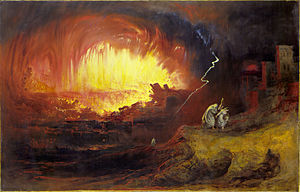
Earth’s Foundation: Fired


Michael Wigglesworth (1631—1705)

CLXXXVI.

Divine Justice offended is,
and satisfaction claimeth;
God’s wrathful ire, kindled like fire.
against them fiercely flameth.
Their Judge severe doth quite cashier,
and all their pleas off take,
That ne’er a man, or dare, or can
a further answer make.

CLXXXVII.

Their mouths are shut, each man is put
to silence and to shame,
Nor have they aught within their thought,
Christ’s Justice for to blame.
The Judge is just, and plague them must,
nor will he Mercy shew,
For Mercy’s day is past away
to any of this Crew.

CLXXXVIII.

The Judge is strong, doers of wrong
cannot his pow’r withstand;
None can by flight run out of sight,
nor ’scape out of his hand.
Sad is their state; for Advocate,
to plead their cause, there’s none;
None to prevent their punishment,
or mis’ry to bemoan.

CLXXXIX.

O dismal day! whither shall they
for help and succor flee?
To God above with hopes to move
their greatest Enemy?
His wrath is great, whose burning heat
no floods of tears can slake;
His Word stands fast that they be cast
into the burning Lake.

CXC.

To Christ their Judge? He doth adjudge
them to the Pit of Sorrow;
Nor will he hear, or cry or tear,
nor respite them one morrow.
To Heav’n, alas! they cannot pass,
it is against them shut;
To enter there (O heavy cheer)
they out of hopes are put.

CXCI.

Unto their Treasures, or to their Pleasures?
All these have them forsaken;
Had they full coffers to make large offers,
their gold would not be taken.
Unto the place where whilom was
their birth and Education?
Lo! Christ begins for their great sins,
to fire the Earth’s Foundation;

Serpent’s Generation: Doomed

Michael Wigglesworth (1631—1705)
The wicked all convinced and put to silence.

CLXXXI.

“A crime it is, therefore in bliss
you may not hope to dwell;
But unto you I shall allow
The easiest room in Hell.“
The glorious King thus answering,
they cease, and plead no longer;
Their Consciences must needs confess
his Reasons are the stronger.

Behold the formidable estate of all the ungodly as they stand
hopeless and helpless before an impartial Judge, expecting their final Sentence.

CLXXXII.

Thus all men’s pleas the Judge with ease
doth answer and confute,
Until that all, both great and small,
are silencéd and mute.
Vain hopes are cropt, all mouths are stopt,
sinners have naught to say,
But that ’tis just and equal most
they should be damn’d for aye.

CLXXXIII.

Now what remains, but that to pains
and everlasting smart,
Christ should condemn the sons of men,
which is their just desert?
Oh rueful plights of sinful wights!
Oh wretches all forlorn!
’T had happy been they ne’er had seen
the sun, or not been born.

CLXXXIV.

Yea now it would be good they could
themselves annihilate.
And cease to be, themselves to free
from such a fearful state.
O happy Dogs, and Swine, and Frogs,
yea, Serpent’s generation!
Who do not fear this doom to hear,
and sentence of Damnation!

CLXXXV.

This is their state so desperate;
their sins are fully known;
Their vanities and villanies
before the world are shown.
As they are gross and impious,
so are their numbers more
Than motes in th’ Air, or than their hair,
or sands upon the shore.

You Sinners Are

Michael Wigglesworth (1631—1705)
The free gift.

CLXXVII.

“I may deny you once to try,
or Grace to you to tender.
Though he finds Grace before my face
who was the chief offender;
Else should my Grace cease to be Grace,
for it would not be free,
If to release whom I should please
I have no liberty.

CLXXVIII.

“If upon one what’s due to none.
I frankly shall bestow,
And on the rest shall not think best
compassion’s skirt to throw,
Whom injure I? will you envy
and grudge at others’ weal?
Or me accuse, who do refuse
yourselves to help and heal ?

CLXXIX.

“Am I alone of what’s my own,
no Master or no Lord?
And if I am, how can you claim
what I to some afford?
Will you demand Grace at my hand,
and challenge what is mine?
Will you teach me whom to set free,
and thus my Grace confine?

CLXXX.

“You sinners are, and such a share
as sinners, may expect;
Such you shall have, for I do save
none but mine own Elect.
Yet to compare your sin with their
who liv’d a longer time,
I do confess yours is much less,
though every sin’s a crime.

Judge Dread Answers: Doom


Michael Wigglesworth (1631—1705)
Their arguments taken off.

CLXXI.

Then answeréd the Judge most dread:
God doth such doom forbid,
That men should die eternally
for what they never did.
But what you call old Adam’s Fall,
and only his Trespass,
You call amiss to call it his,
both his and yours it was.

CLXXII.

“He was design’d of all Mankind
to be a public Head;
A common Root, whence all should shoot,
and stood in all their stead.
He stood and fell, did ill or well,
not for himself alone.
But for you all, who now his Fall
and trespass would disown.

CLXXIII.

“If he had stood, then all his brood
had been establishéd
In God’s true love never to move,
nor once awry to tread;
Then all his Race my Father’s Grace
should have enjoy’d for ever.
And wicked Sprites by subtile sleights
could them have harméd never.

CLXXIV.

Would you have griev’d to have receiv’d
through Adam so much good,
As had been your for evermore,
if he at first had stood?
Would you have said, ’We ne’er obey’d
nor did thy laws regard;
It ill befits with benefits,
us, Lord, to so reward?’

CLXXV.

“Since then to share in his welfare,
you could have been content,
You may with reason share in his treason,
and in the punishment.
Hence you were born in state forlorn,
with Natures so depravéd;
Death was your due because that yo
had thus yourselves behavéd.

CLXXVI.

“You think ’If we had been as he
whom God did so betrust,
We to our cost would ne’er have lost
all for a paltry lust.’
Had you been made in Adam’s stead,
you would like things have wrought,
And so into the self-same woe,
yourselves and yours have brought.