
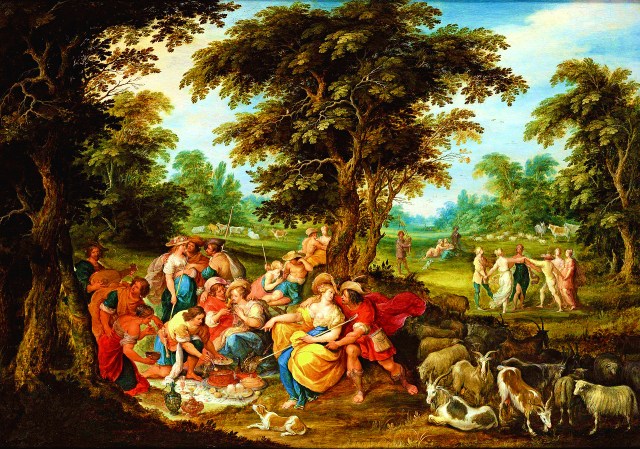
Attend, ye Nine, and careless swains:
descending to Arcadia’s plains
a playful Zephyr wind of love
now stirs the leaves of Venus‘ grove.
By Philomela‘s unshorn flocks
and bright Diana‘s flowing locks
my classic naiad air now brings
a gushing fountain’s hidden springs.
O’er verdant fields and greening rill
my lay shall fauns with satyrs thrill.
Ye swains and shepherdesses, come!
Adore the world’s Arcadian bum.
Flora, banished from Eden, thrives
Sweetening hidden honey hives
whose swarms of workers never tire
providing flow’ry heart’s desire.
Cupid spreads his fluttering plumes;
and Nature wanton pose assumes
uncovering her dales and glades
before her early glory fades.
The captivating limbs of grace
now parted, show her lower face,
where clefts are glimpsed—ravines, or chasms;
shuddering, bursting forth in spasms.
Earth thus trembles. See her quake
and ruin of GOD’s creation make.
Wisdom, fallen, pawns her crown
as high ideals come crashing down.
So o’er the fields, my pastoral lay
sets Aeolus blowing on his way.
Now thyrsus-bearing maenads pass
and Bacchus rides upon his ass.
(A different ass should be adored
that fair creation of the LORD,
which gently rounded, swells the mind
with thoughts unhallowed, unrefined.)
This second ass we long to ride;
until she comes—our load inside.
But burdened beasts deserve no spite,
nor does my Poetry, despite
the fact that Porn has made us dumb
reducing us to spurts of come . . .
So chaste (and chased) celestial virgins
turn to trees at Classic urgings.
Eros spreads his wings (her legs)
inviting us to drain the dregs
while Ceres‘ tawny limbs now shake
as harvests man would undertake.
Old Pan gives rise to Attic fears
(as well the sav’ry bacon sears),
whose pipes the purling brooks enjoy
and streams flow faster, for their joy.
The golden past see here, anew
in rosy and poetic hue:
Will nature be reduced to porn?
Shall nymphs of pleasure, newly born
who bare their charming whole to all
cast womanhood in a dying fall
before a camera, there, to fawn
and light the rosy-fingered dawn?
If so, I say let’s get it lit
(since literature might help a bit)
and in the daybreak’s fervid light
we’ll now make out fair nature’s sight:
appendages outspread, well-splayed
where once the sprite and dryad played.
Such fertile pastures, mounds, and woods,
a panoply of carnal goods
our undulating field of bliss
make misconceptions: hit and miss.
These wetlands, groves, and bounteous limbs
enthralled to lust’s capricious whims
make sweet Diana seek her quarry.
(far too late to say I’m sorry . . .)
Sex, our motivating prize
displayed in fleshly glory lies.
Her fanes are reared, which sounds obscene
where once raw Nature reigned serene.
Halcyon visions of the hunt
direct our carnal minds to C – – t!
The blessed light, transcending hope
and rolling o’er each grassy slope
begins to shine on darkened waters,
stirring up the river daughters;
waking schools of silvery fish
who glide along their final wish:
to flee the sharpened hook of fate
upon which squirms the Master’s bait.
While Phoebus floods the surface bright
with beams of pure poetic light.
This Heaven, following hard on Hell
is less a Babylonian spell
than pure devotion, misdirected
(and a pagan shrine erected).
where the poets sing too long.
Now hearken well: I’ll close my song.
Don’t harden your dull heart in hate;
just glimpse the garden from her gate.
And view those less celestial skies
receding in her human eyes
Until these dear idyllic scenes
inspired by purely digital means
reveal, at last, a digital end
and past with present bravely blend.
Enough of flocks of stinking sheep
who eat and wander, bleat and sleep.
Who copulate, and piss and shit
as if their lives depend on it . . .
Instead, I’ll sing of human being
beneath the eye of One all-seeing.
Ye watchers of the erring flock,
and pastors whom the crowing cock
awakes from sleep’s Elysian fields,
attune your souls. My poem yields
an end to this Arcadian story
(it was naught but allegory).
Such fleshly charms are quite a treat
and mutton-chops make hearty meat.


 CONNECT/HOOK