Wild Hemispheres: The Columbiad

Juaneco y su combo: PERÚ

Near and more near the long drawn coasts arise,
Bays stretch their arms and mountains lift the skies,
The lakes, high mounded, point the streams their way,
Slopes, ridges, plains their spreading skirts display,
The vales branch forth, high walk approaching groves,
And all the majesty of nature moves…

O’er the wild hemisphere his glances fly,
Its form unfolding as it still draws nigh,
As all its salient sides force far their sway,
Crowd back the ocean and indent the day…

Columbus traced, with swift exploring eye,
The immense of waves that here exalted lie,
The realms that mound the unmeasured magazine,
The far blue main, the climes that stretch between.
He saw Xaraya’s diamond banks unfold,
And Paraguay’s deep channel paved with gold,
Saw proud Potosi lift his glittering head,
And pour down Plata thro his tinctured bed.
Rich with the spoils of many a distant mine,
In his broad silver sea their floods combine;
Wide over earth his annual freshet strays,
And highland drains with lowland drench repays;
Her thirsty regions wait his glad return,
And drink their future harvest from his urn…

So taught the Saint. The regions nearer drew,
And raised resplendent to their Hero’s view
Rich nature’s triple reign; for here elate
She stored the noblest treasures of her state,
Adorn’d exuberant this her last domain,
As yet unalter’d by her mimic man,
Sow’d liveliest gems, and plants of proudest grace,
And strung with strongest nerves her animated race.

[excerpts from The Columbiad, Book I  by Joel Barlow, published in 1807]
indian pipe girl pin up
IMAGE CREDIT: therealrevo.com

Gnostic Gnonsense & Andean Vistas

inca-dream-herge

Lest fellow members of the body misconstrue my Andean longings, let us comprehend,
O loyal connectees, the corporeal metaphor sublimated, transmuted into empyrean fire
and rendered universal by St. Paul of Tarsus the founder of our holy and elect communities, when he wrote:

All flesh is not the same flesh: but there is one kind of flesh of men, another flesh of beasts, another of fishes, and another of birds. There are also celestial bodies, and bodies terrestrial: but the glory of the celestial is one, and the glory of the terrestrial is another. There is one glory of the sun, and another glory of the moon, and another glory of the stars: for one star differeth from another star in glory. So also is the resurrection of the dead. It is sown in corruption; it is raised in incorruption: It is sown in dishonour; it is raised in glory: it is sown in weakness; it is raised in power.

[I Corinthians 15:39-43]

The decentralized undulating landscapes of terrestrial desire can be confused with celestial bodies, yes, but the astral bodies are free from carnal taint. And it is only in the night devoid of lunar light that the celestial bodies may be clearly glimpsed…

But enough gnostic gnonsense —

let us depart for the lyrical peaks of the Andes with Joel Barlow as our guide. Capac and Oella await us there on the distant and sacred summit.
capac & oella

Fixing our sight on those majestic heights,
we nonetheless begin the ascent
through Amazonian  jungle headwaters.

TT Broken Ear

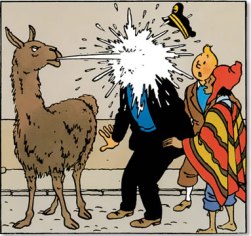
 Our llamas are well-provisioned with coca, pisco and papas

Tintin en la selva     Prisoners of the Sun LLAMA

IMAGE CREDIT: Hergé – Prisoners of the Sun / The Broken Ear
landesfes / Caroline Savard @ Deviant ART
 

Hasty Pudding

The poem is here.

In spite of the all-male camp theater club at Harvard [my mom once took me to see a Hellenic/Olympian production there called Keep Your Pantheon] that took their name from this  New England dish, Joel Barlow‘s mock epic remains one of my favorite American poems.
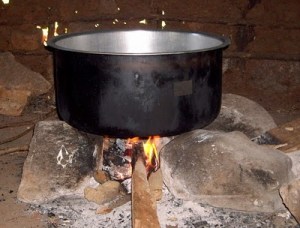
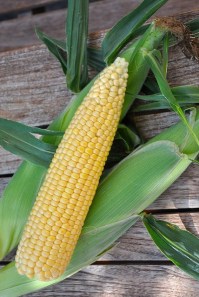
Barlow traces the elemental dish back to Peru by way of Europe – but he never knew how beloved  the hasty  pudding [maize-meal porridge] is in Africa. I lived in East Africa for 7 years growing up and I know that Kenya and many other nations survive on this stuff. My son loves it because it is like play-dough – it can be modeled into shapes and then eaten. In Africa it is usually consumed with a stew of some kind but poor people will subsist on it by itself. It can also be made less thick and sweetened for breakfast,  like cream of wheat.

In Kenya it is called Ugali.  In Uganda and other parts of E. Africa they call it Posho [rations]

In Malawi and Zimbabwe it is known as Shima. My South African friend cooked some up for us years ago and called it “Mealie Paps“.

About the poem: you have to be in the right frame of mind to read it.  It is quite  long.

Some will find it hard to stare at a screen for all those stanzas.  I prefer to read it in print, but regardless of in what form you consume The Hasty Pudding, you will be richly rewarded and sated when you finish.  The first canto has the greatest opening and says a lot about how Americans thought of themselves in the days after our independence from Britain:

Ye Alps audacious, through the heavens that rise,
To cramp the day and hide me from the skies;
Ye Gallic flags, that o’er their heights unfurled,
Bear death to kings, and freedom to the world,
I sing not  you.

And with that you are in for a ride…If you like it, go back and read the preface.

I didn’t include it on the poem page since people might never make it through!