Mystery is Only the Veil of God’s Face…

God has still His hidden secrets, hidden from the wise and prudent.
Do not fear them; be content to accept things that you cannot understand; wait patiently. Presently He will reveal to you the treasures of darkness, the riches of the glory of the mystery.   Mystery is only the veil of God’s face […] God is nigh. He is in the dark cloud. Plunge into the blackness of its darkness without flinching; under the shrouding curtain of His pavilion you will find God awaiting you.

Hast thou a cloud?
Something that is dark and full of dread;
A messenger of tempest overhead?
A something that is darkening the sky;
A something growing darker bye and bye;
A something that thou fear’st will burst at last;
A cloud that doth a deep, long shadow cast,
God cometh in that cloud.
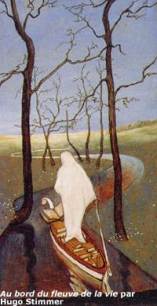
Hast thou a cloud?
It is Jehovah’s triumph car: in this
He rideth to thee, o’er the wide abyss.
It is the robe in which He wraps His form;
For He doth gird Him
with the flashing storm.

It is the veil in which He hides the light
Of His fair face, too dazzling for thy sight.
God cometh in that cloud.

 Hast thou a cloud?
 A trial that is terrible to thee?
 A black temptation threatening to see?
 A loss of some dear one long thine own?
 A mist, a veiling, bringing the unknown?
  A mystery that unsubstantial seems:
A cloud between thee
and the sun’s bright beams?

     God cometh in that cloud.

 Hast thou a cloud?
  A sickness–weak old age–distress and death?
  These clouds will scatter at thy last faint breath.
  Fear not the clouds that hover o’er thy barque,
  Making the harbour’s entrance dire and dark;
  The cloud of death, though misty, chill and cold,
  Will yet grow radiant with a fringe of gold.
  GOD cometh in that cloud.

(From Streams in the Desert, public domain version © 1925 )

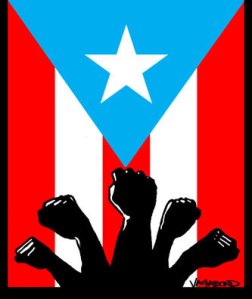
Viva la (ilumi)nación Boricua

I live and work with Latinos from many different nations, but the overwhelming majority are Puerto Ricans. As a gringo who is interested in cultural history, I am furthering my knowledge of Puerto Rico bit by bit. I recently learned that there are 2 different anthems for the island of the Tainos known before Columbus as Borinquen. I present both to you today. First, the original lyrics from 1868 which are extremely militant. It was written as a revolutionary poem by Lola Rodríguez de Tió before the second, later version became official. The name of the anthem is La Borinqueña

¡Despierta, borinqueño
que han dado la señal!
¡Despierta de ese sueño
que es hora de luchar!
A ese llamar patriótico
¿no arde tu corazón?
¡Ven! Nos será simpático
el ruido del cañón.
Mira, ya el cubano
libre será;
le dará el machete
su libertad…
le dará el machete
su libertad.
Ya el tambor guerrero
dice en su son,
que es la manigua el sitio,
el sitio de la reunión,
de la reunión…
de la reunión.
El Grito de Lares
se ha de repetir,
y entonces sabremos
vencer o morir.
Bellísima Borinquén,
a Cuba hay que seguir;
tú tienes bravos hijos
que quieren combatir.
ya por más tiempo impávido
no podemos estar,
ya no queremos, tímidos
dejarnos subyugar.
Nosotros queremos
ser libre ya,
y nuestro machete
afilado está.
y nuestro machete
afilado está.
¿Por qué, entonces, nosotros
hemos de estar,
tan dormidos y sordos
y sordos a esa señal?
a esa señal, a esa señal?
No hay que temer, riqueños
al ruido del cañón,
que salvar a la patria
es deber del corazón!
ya no queremos déspotas,
caiga el tirano ya,
las mujeres indómitas
también sabrán luchar.
Nosotros queremos
la libertad,
y nuestros machetes
nos la darán…
y nuestro machete
nos la dará…
Vámonos, borinqueños,
vámonos ya,
que nos espera ansiosa,
ansiosa la libertad.
¡La libertad, la libertad!
Arise, Boricua! The call to arms has sounded!
Awake from the slumber, it is time to fight!
Doesn’t this patriotic call set your heart alight?
Come! We are in tune with the roar of the cannon.
Come, the Cuban will soon be free;
the machete will give him his liberty,
the machete will give him his liberty.
Now the war drum says with its sound,
that the countryside is the place of the meeting.
The Cry of Lares must be repeated, and then we will know:
victory or death.
Beautiful Borinquén must follow Cuba;
you have brave sons who wish to fight.
Now, no longer can we be unmoved;
now we do not want timidly to let them subjugate us.
We want to be free now, and our machete has been sharpened.
Why then have we been so sleepy and deaf to the call?
There is no need to fear, ‘Ricans, the roar of the cannon;
saving the nation is the duty of the heart.
We no longer want despots, tyranny shall fall now;
the unconquerable women also will know how to fight.
We want liberty, and our machetes will give it to us.
Come, Boricuas, come now, since freedom awaits us anxiously,
freedom, freedom!
We want Freedom,
And our machetes will give it to us …
And our machete will give it to us…
Come on, Borinquen, let’s go, Liberty awaits us anxiously,
Freedom, freedom!

The modern lyrics, from 1903 and made official in 1952 by Luis Muñoz Marín are toned-down and speak of tropical gardens and sunny beaches:

La tierra de Borinquen donde he nacido yo
es un jardín florido de mágico primor.
Un cielo siempre nítido le sirve de dosel
y dan arrullos plácidos las olas a sus pies.
Cuando a sus playas llegó Colón
exclamó lleno de admiración: “Oh!, oh!, oh!,
ésta es la linda tierra
que busco yo.”

Es Borinquen la hija,  la hija del mar y el sol,
del mar y el sol,
del mar y el sol, del mar y el sol, del mar y el sol.


The land of Borinquen where I was born
is a flowery garden
of magical beauty.

A constant clear sky serves as its canopy
and placid lullabies are sung by the waves at its feet.

When at her beaches Columbus arrived full of awe
he exclaimed,
“Oh!, oh!, oh!, this is the lovely land that I seek.”

Borinquen is the daughter, the daughter of the sea and the sun.
Of the sea and the sun, of the sea and the sun, of the sea and the sun, of the sea and the sun.

Somewhere between these 2 versions is the present day reality of PR.
This video is a cynical view of the current state of affairs…

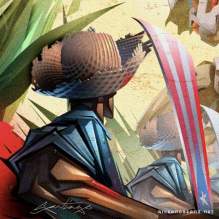
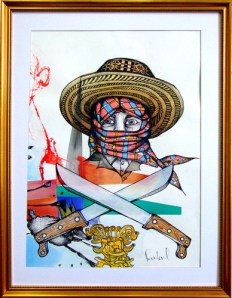
Machetero image by Derek Santiago: www.riceandbeanz.net

Washed up and hung on the line to Dryden…

…Thy inoffensive satires never bite.
In thy felonious heart though venom lies,
It does but touch thy Irish pen, and dies.
Thy genius calls thee not to purchase fame
In keen iambics, but mild anagram.
Leave writing plays, and choose for thy command
Some peaceful province in acrostic land.
There thou mayst wings display and altars raise,
And torture one poor word ten thousand ways…

John Dryden: MacFlecknoe

Yes – it could be said of me and my scrawling.
(I dabble in acrostics as my long-suffering poetry acquaintances can testify).

John Dryden wrote lines 3 centuries ago that still sting poetasters like me.
It hurts so good.

He could have been writing part of my unapproved biography here  (just call me Zimri):

…In the first rank of these did Zimri stand:
A man so various, that he seem’d to be
Not one, but all Mankind’s Epitome.
Stiff in opinions, always in the wrong;
Was everything by starts, and nothing long:
But in the course of one revolving moon,
Was chemist, fiddler, statesman, and buffoon:
Then all for women, painting, rhyming, drinking;
Besides ten thousand freaks that died in thinking.
Blest madman, who could every hour employ,
With something new to wish, or to enjoy!
Railing and praising were his usual themes;
And both (to show his judgment) in extremes:
So over violent, or over civil,
That every man, with him, was god or devil…

 John Dryden: Absalom and Achitophel

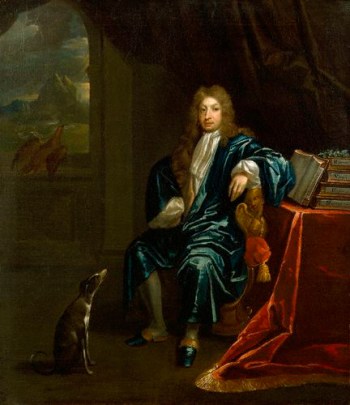
John Dryden was a great poet. Not only could he write nasty satires about the political movers and shakers of his day thinly disguised as Old Testament history; he also wrote thunderous lyrics such as one of my all-time favorite poems  A Song For St. Cecelia’s Day, 1687.

Talk about a true Rock Star !  He was Poet Laureate of England for a while.

Dryden was born of Puritan parents and became an Anglican – only to convert to Roman Catholicism later in his life. We can forgive him for that.

You can learn way too much about his poetry here – really funny stuff, some of it.

I leave you with the celestially stupendous final lines of the above-mentioned Song for St. Cecelia:

♪♫  Grand Chorus  ♪♫♪

As from the power of sacred lays
The spheres began to move,
And sung the great Creator’s praise
To all the bless’d above;
So when the last and dreadful hour
This crumbling pageant shall devour,
The trumpet shall be heard on high,
The dead shall live, the living die,
And Music shall untune the sky.


Compelling Acapella

Yo Yo Yo PILGRIMHYMNS in the house!

My homegirls is bringing you Psalm 34,
straight outta GENEVA –
1536 style

…proving once again that the mediocre majority are headed to Gehenna unless granted repentance by our Sovereign Savior in His amazing predestinating grace.

Dig those tersely closed dento-lingual terminal consonants!

PilgrimHymns slam the REAL poetry. 

Old-school sistaz kickin’ it to the curb...

Nuff respeck due.