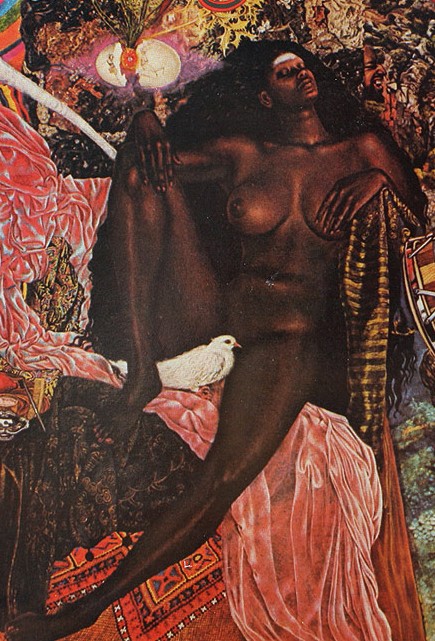
These lines are from “The Annunciation” (the Angel Gabriel is speaking):
“Ave,” he said, and after that, “Maria.
Rejoice because the Lord’s eternal love
Has made you pregnant – not by orthodox
Methods, of course. The Pentecostal dove
Came silently and nested in your box.”
“A hen?” she blushed. “For I know nothing of -“
The angel nodded, knowing she meant cocks.
Burgess seems to have derived his theory of poetry from Robert Graves’s eccentric but (in its day) widely influential critical book, The White Goddess (1948). Graves spoke of poetry as “a wild Pentecostal speaking with tongues”, and Burgess writes in one of his own poems that “the Pentecostal sperm came hissing down” at the moment of creative generation. This is how he believed poems got made: by a process of insemination from without, or (as Graves puts it) through “religious invocation of the Muse, the experience of mixed exaltation and horror that her presence excites”.
This theory of poetry is played out most conspicuously in the four comic novels that Burgess wrote about his alter ego, the sociopathic poet Francis Xavier Enderby, who composes most of his best work on the lavatory seat (which he likens to Shakespeare’s “wooden O”). Enderby is literally inspired, in the strict sense of having words breathed into him, by a mystical white goddess, his ethereal muse. Within the fictional frame, Burgess’s own early poems are reattributed to Enderby, including a sequence of five sonnets (the “Revolutionary Sonnets” of this volume’s title) which won the mild approval of TS Eliot, to whom Burgess had sent them in the early 1950s:
A dream, yes, but for everyone the same.
The thought that wove it never dropped a stitch.
The absolute was everybody’s pitch,
For, when a note was struck, we knew its name.
That dark aborted any wish to tame
Waters that day might prove to be a ditch
But then was endless growling ocean, rich
In fish and heroes till the dredgers came.
Wachet auf! A fretful dunghill cock
Flinted the noisy beacons through the shires.
A martin’s nest clogged the cathedral clock,
But it was morning: birds could not be liars.
A key cleft rusty age in lock and lock.
Men shivered by a hundred kitchen fires.
Image credit: detail from Annunciation (1961) by Mati Klarwein

 CONNECT/HOOK