Poetic – but Look Out for the Cobra

       Etiopia Yemen
The kings of Tarshish and of the isles shall bring presents: 
the kings of Sheba and Seba shall offer gifts.
Yea, all kings shall fall down before him: all nations shall serve him.
For he shall deliver the needy when he crieth;
the poor also, and him that hath no helper.
He shall spare the poor and needy, and shall save the souls of the needy.
He shall redeem their soul from deceit and violence:
and precious shall their blood be in his sight.
And he shall live, and to him shall be given of the gold of Sheba:
prayer also shall be made for him continually; and daily shall he be praised.
Psalm 72 [KJV]

Archaeologists strike gold in quest to find Queen of Sheba’s wealth

An initial clue lay in a 20 ft stone stele (or slab) carved with a sun and crescent moon, the “calling card of the land of Sheba”, Schofield said. “I crawled beneath the stone – wary of a 9 ft cobra I was warned lives here – and came face to face with an inscription in Sabaean, the language that the Queen of Sheba would have spoken.”    […]

Sheba was a powerful incense-trading kingdom that prospered through trade with Jerusalem and the Roman empire. The queen is immortalised in Qur’an and the Bible, which describes her visit to Solomon “with a very great retinue, with camels bearing spices, and very much gold and precious stones … Then she gave the king 120 talents of gold, and a very great quantity of spices.”

Although little is known about her, the queen’s image inspired medieval Christian mystical works in which she embodied divine wisdom, as well as Turkish and Persian paintings, Handel’s oratorio Solomon, and Hollywood films. Her story is still told across Africa and Arabia, and the Ethiopian tales are immortalised in the holy book the Kebra Nagast.

Sean Kingsley, archaeologist and author of God’s Gold, said: “The idea that the ruins of Sheba’s empire will once more bring life to the villages around Maikado is truly poetic and appropriate. Making the past relevant to the present is exactly what archaeologists should be doing. “

from: theguardian.com
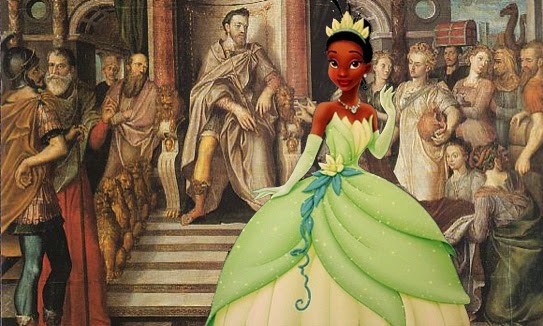
 

The Reflected Glory: Sheba’s Throne

https://connecthook.net/wp-content/uploads/2015/03/60990-salomon-saba-gante-disney-543po.jpg

According to the holy Quran, Balqis heard about the wisdom of Prophet Solomon (Peace be upon him), and decided to visit his court after he invited her to abandon her old religion of worshipping the sun, and convert to worship God. She decided to overwhelm the wise Solomon with her fabulous gifts. Realizing that, the King managed to build a palace on the sea with a glass floor so pure that when she lifted her gown lest it touched the seawater. But what stunned her was to see her own, famous throne in front of her, so far away from where she left it.

from :  Women of Distinction: Balqis, Queen of Sheba

IMAGE CREDIT:  eden-saga.com


Meditation upon “Annunciation” by Mati Klarwein, 1961

https://simotron.files.wordpress.com/2013/10/annunciation.jpg

Saharan angels chant their song of abundance before a Cainite altar where the enigmatic artist laughs a jibaro-hippie laugh / Red conga-anima rides the rhythm / signalling to the drowsing Queen of the South lost in a vision at the wall of Jerusalem / she must lift her gaze to heaven / turn from her vanity and behold the celestial sign / Aleph-Alpha the cipher of Messiah / the egg breaks open: flowering zygote of conception / blood of the pomegranate, granada / blood of the goat flayed on the altar of mammon / terraces of chilies exuding fire in the crystalline torpor of a Mexican fishing village / hear the clear salt water at the foot of the stairs / hear the music’s underwater depths / hear the syncopated overcoding of this annunciation / the lilies rise, shoshannim / Shushan the citadel / nomadic deserts of the outer horizon threaten the opulent decadence of the jeweled elephant-headed idol of the world / Orpheus looks back emerging from the portal stairs into the burning light of the living / BEHOLD: Eurydice one last time in perfection and it all vanishes


PROMPT # 22: write a poem that engages with another art form […]
a wonderful painting, film, or piece of music you’ve experienced –
so long as it uses the poem to express something about another form of art.

www.matiklarweinart.com

Sinister Solomonic Insinuations

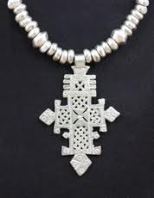
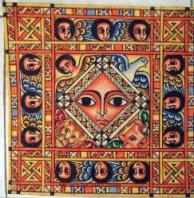
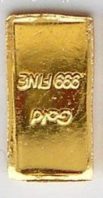
ethiopian crucifix    Eth Icon    GOLD666

Etiopia Yemen

WE cannot tell exactly who the Queen of the South was,
nor exactly where Sheba lay. The expression used is Yemen, the south. Yemen is the name of a part of Arabia Felix and it would appear from the spices which the Queen brought with her that she came from that region. At the same time, the Abyssinians claim her as having been their queen. They say that she was converted through her conversations with Solomon, that afterwards the faith of God was preserved in the country, and hence that that famous Ethiopian, who was a eunuch of great authority under Candace in later times, was a proselyte to the Jewish faith on account of that faith existing in Abyssinia. 

A Greater Than Solomon 
[Sermon #3166 by Charles Spurgeon – published October 14, 1909]

www.spurgeongems.org

And King Solomon gave to the queen of Sheba all that she desired, whatever she asked besides what was given her by the bounty of King Solomon. So she turned and went back to her own land with her servants. Now the weight of gold that came to Solomon in one year was 666 talents of gold, besides that which came from the explorers and from the business of the merchants, and from all the kings of the west and from the governors of the land.

1 Kings 10:13-15 [ESV]

No mention shall be made of coral, or of pearls:
for the price of wisdom is above rubies.
The topaz of Ethiopia shall not equal it,
neither shall it be valued with pure gold.

Job 28: 18-19 [KJV]

This calls for wisdom:
let the one who has understanding
calculate the number of the beast,

for it is the number of a man, and his number is 666.

Revelation 13:18

ICON IMAGE CREDIT: Simaschew Mesfin, from  http://www.betsyporter.com