Day of Doom: Get Ready

The Day of Doom, a quintessentially Puritan poem of over 200 eight-line stanzas vividly describing Judgment Day and the torments awaiting sinners in Hell, was the first book of poetry printed in the American Colonies and the first American bestseller. Its author, Michael Wigglesworth, graduated from Harvard in 1651 and served the town of Malden, Mass., as minister and physician. The day of doom is the foundation of any collection of early American literature, yet it is also one of the legendary rarities of early American printing. Only one fragmentary copy survives of the first edition, printed in Cambridge, Mass., ca. 1662, and only four fragmentary copies of the second edition of 1666.

This Just In: We Welcome The Day of Doom!


I will be posting this edifying New England poem here at ConnectHook soon.
I discovered it in this excellent anthology I purchased recently:

Kushitic Closure

This poem is inspired by memories of a lovely and kind-hearted Ethiopian university student who lived with my family when I was ten. She introduced us to berbere and doro wat, and taught me to appreciate gastronomy from Africa’s horn. She had a beautiful smile, she had a Wilson Pickett record and she initiated me into the mysteries of pop music and the radio. Her name was Adeye. This was in the mid-70’s just before the Marxist coup which brought in Haile Mengistu Mariam. We lost touch with her long ago. The poem is also inspired by times I have been offered coffee among Ethiopian people, who have a beautiful ceremony involving frankincense when they partake.

One last Kushitic dream—be patient: once I was at the Boston Museum of Fine Arts, in the Egyptian mummy room (a Coptic one-liner there for you). I was chatting with a beautiful Eritrean security guard among the crypts. Mysteriously, everyone cleared out and for a short while it was only the two of us, surrounded by opened sarcophagi in the dimly-lit room. For a moment I thought I was speaking with the eternal spirit of some princess who had just climbed out of one of them !


Kaffa-Coffee

Abyssinia

I long to know that land in spirit
where the highlands meet the desert.
Where there’s faith and coffee served
with ceremony still observed.

The white-robed land, where priests intone
in levite ritual ‘round the ark.
A land in clouds of frankincense,
whose past is bitter, strong and dark. 

meroe02

I’ll enter where the rock is carved
in cruciform epiphany;
where Midian’s curtains hide the starved

whose hunger feeds conspiracy. 

I’ll walk the wilds of Meroë
all ruined in the desert sands,ethiop cross
where beauty wails and ululates
as silver gleams on amber strands.

Her kings and peasants come to naught
when princes’ plots are overthrown.
Her blameless name was never bought;
her faith in Christ is scribed in stone.
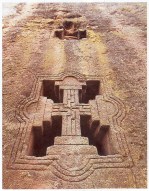
lalibela04

Queen Sheba’s golden sepulcher – 
your modern guises can’t suffice
to quench the fire of God and spice.

Davidic land—like calvary
your power purifies the heart
through struggle, prayer, and ancient art.

An Art Of Poetry


To Vincent Buckley

Since all our keys are lost or broken,
Shall it be thought absurd
If for an art of words I turn
Discreetly to the Word?

Drawn inward by his love, we trace
Art to its secret springs:
What, are we masters in Israel
And do not know these things?

Lord Christ from out his treasury
Brings forth things new and old:
We have those treasures in earthen vessels,
In parables he told,

And in the single images
Of seed, and fish, and stone,
Or, shaped in deed and miracle,
To living poems grown.

Scorn then to darken and contract
The landscape of the heart
By individual, arbitrary
And self-expressive art.

Let your speech be ordered wholly
By an intellectual love;
Elucidate the carnal maze
With clear light from above.

Give every image space and air
To grow, or as bird to fly;
So shall one grain of mustard-seed
Quite overspread the sky.

Let your literal figures shine
With pure transparency:
Not in opaque but limpid wells
Lie truth and mystery.

And universal meanings spring
From what the proud pass by:
Only the simplest forms can hold
A vast complexity.

We know, where Christ has set his hand
Only the real remains:
I am impatient for that loss
By which the spirit gains.


James McAuley (1917–1976)