Rasselas: Resolved to be a Poet

“Wherever I went I found that poetry was considered as the highest learning, and regarded with a veneration somewhat approaching to that which man would pay to angelic nature. And yet it fills me with wonder that in almost all countries the most ancient poets are considered as the best; whether it be that every other kind of knowledge is an acquisition greatly attained, and poetry is a gift conferred at once; or that the first poetry of every nation surprised them as a novelty, and retained the credit by consent which it received by accident at first; or whether, as the province of poetry is to describe nature and passion, which are always the same, the first writers took possession of the most striking objects for description and the most probable occurrences for fiction, and left nothing to those that followed them but transcription of the same events and new combinations of the same images. Whatever be the reason, it is commonly observed that the early writers are in possession of nature, and their followers of art; that the first excel in strength and invention, and the latter in elegance and refinement.

“I was desirous to add my name to this illustrious fraternity. I read all the poets of Persia and Arabia, and was able to repeat by memory the volumes that are suspended in the mosque of Mecca. But I soon found that no man was ever great by imitations. My desire of excellence impelled me to transfer my attention to nature and to life. Nature was to be my subject, and men to be my auditors. I could never describe what I had not seen. I could not hope to move those with delight or terror whose interests and opinions I did not understand.

“Being now resolved to be a poet, I saw everything with a new purpose; my sphere of attention was suddenly magnified; no kind of knowledge was to be overlooked. I ranged mountains and deserts for images and resemblances, and pictured upon my mind every tree of the forest and flower of the valley. I observed with equal care the crags of the rock and the pinnacles of the palace. Sometimes I wandered along the mazes of the rivulet, and sometimes watched the changes of the summer clouds. To a poet nothing can be useless.


from: Rasselas by Samuel Johnson, 1759

Dubbed by the Queen of the South

Knights of the Greater Ithiopia / rise before Her Majesty / Enthroned in echoing sound-waves / trinity of rhythm code revealed in drumbeats mathematical precision of Truth / moving out across God’s universe / dubbed into all languages / a greater than Solomon lives and reigns / serve wisdom / plead for wisdom / dub echoes shimmer and die, rise reborn, depart for the throne / behold gnostic error / reverberations of Faith / the Dragon is slain / in every passing second…

More YABBY  YOU
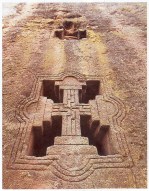
ethiopian crucifix

Queen of the South REVEALED 

Kushitic Closure

I end my Abyssinian blog posts with a poem I wrote several years ago.
It may be indirectly inspired by memories of a lovely and kind-hearted Ethiopian university student who lived with my family when I was 10. She introduced us to berbere and doro wat, and set me up to appreciate gastronomy from Africa’s horn for a long time to come. She had a beautiful smile,  she had a Wilson Pickett record and she initiated me into the mysteries of pop music and the radio. Her name was Adeye. This was in the mid-70’s just before the Marxist coup which brought in Haile Mengistu Mariam. We lost touch with her long ago. The poem is also inspired by times I have been offered coffee among Ethiopian people, who have a beautiful ceremony involving frankincense when they partake.

One last Kushitic dream—be patient:  once I was at the Boston Museum of Fine Arts, in the Egyptian mummy room. I was chatting for a while with a beautiful Eritrean security guard among the crypts. Mysteriously, everyone cleared out and for a short while it was only the two of us, surrounded by opened sarcophagi in the dimly-lit room. For a moment I thought I was speaking with the eternal spirit of some Nubian princess who had just climbed out of one of them !

(Of course Psalm 68 in the King James Version also had something to do with my Ethiopic overload…) Now my poem:

Kaffa-Coffee

Abyssinia

I long to know that land in spirit
where the highlands meet the desert.
Where there’s faith and coffee served
with ceremony still observed.

The white-robed land, where priests intone
in levite ritual ‘round the ark.
A land in clouds of frankincense,
whose past is bitter, strong and dark. 

meroe02

I’ll enter where the rock is carved
in cruciform epiphany;
where Midian’s curtains hide the starved

whose hunger feeds conspiracy. 

I’ll walk the wilds of Meroë
all ruined in the desert sands,ethiop cross
where beauty wails and ululates
as silver gleams on amber strands.

Her kings and peasants come to naught
when princes’ plots are overthrown.
Her blameless name was never bought;
her faith in Christ is scribed in stone.

lalibela04

Queen Sheba’s golden sepulcher – 
your modern guises can’t suffice
to quench the fire of God and spice.

Davidic land—like calvary
your power purifies the heart
through struggle, prayer, and ancient art.

Virtual Windows: Ethiopia

For serious fun, experiment with running 2 YouTubes at once,
muting one while listening to another to get new effects !

 Satta Amassagana  means “Give Thanks” in Amharic.
This is the horns dub of  Studio 1 version from 1969

  I am black, but comely, O ye daughters of Jerusalem,
as the tents of Kedar, as the curtains of Solomon.   
[Song of Solomon 1:5]

From beyond the rivers of Ethiopia, my worshipers,
the daughter of My dispersed ones, shall bring My offering.  
[Zephaniah 3:9,10]

Virtual excursion to Lalibela