Wild Hemispheres: The Columbiad

Juaneco y su combo: PERÚ

Near and more near the long drawn coasts arise,
Bays stretch their arms and mountains lift the skies,
The lakes, high mounded, point the streams their way,
Slopes, ridges, plains their spreading skirts display,
The vales branch forth, high walk approaching groves,
And all the majesty of nature moves…

O’er the wild hemisphere his glances fly,
Its form unfolding as it still draws nigh,
As all its salient sides force far their sway,
Crowd back the ocean and indent the day…

Columbus traced, with swift exploring eye,
The immense of waves that here exalted lie,
The realms that mound the unmeasured magazine,
The far blue main, the climes that stretch between.
He saw Xaraya’s diamond banks unfold,
And Paraguay’s deep channel paved with gold,
Saw proud Potosi lift his glittering head,
And pour down Plata thro his tinctured bed.
Rich with the spoils of many a distant mine,
In his broad silver sea their floods combine;
Wide over earth his annual freshet strays,
And highland drains with lowland drench repays;
Her thirsty regions wait his glad return,
And drink their future harvest from his urn…

So taught the Saint. The regions nearer drew,
And raised resplendent to their Hero’s view
Rich nature’s triple reign; for here elate
She stored the noblest treasures of her state,
Adorn’d exuberant this her last domain,
As yet unalter’d by her mimic man,
Sow’d liveliest gems, and plants of proudest grace,
And strung with strongest nerves her animated race.

[excerpts from The Columbiad, Book I  by Joel Barlow, published in 1807]
indian pipe girl pin up
IMAGE CREDIT: therealrevo.com

School of Soft Knox

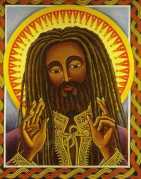
By way of closure to my recent Abyssinian musings, I offer my loyal connectees this doctrinally reformed limerick for their elect delectation.
(Of course, no Presbyterian has to ask what millenarian means…)

A sober and staid Presbyterian
was distrustful of thoughts millenarian.
After smoking some bud,
He awoke with a thud;
in his sleep he’d become Rastafarian.

L of J  rasta icon  presbyterian shirt

Psalm 68

Mexicanismo Posmodernista

In the Pre-Columbian and pre-patriarchal text above, the “Tía” clearly plays a radicalizing role in the context of narco-anarchy on the frontier. There is an intensification of the polarizing dynamic between striated regimentation in the person of the narrator who attempts to name, itemize, and commodify garments and the Tía herself who, as an empowered change agent, uses her radical femininity to challenge the patriarchy and the dominant hegemony of machismo within the outlaw context of narcotrafficking.

See Chandler on Barthes and the garment system:

1. She selects signs from three paradigms (i.e. sets of possible signs – upper body garments, lower body garments, and footwear). Each paradigm contains a possible set of pieces from which she can choose only one. From the upper-body-garment paradigm (including blouses, tee-shirts, tunics, sweaters), she selects one. These items share a similar structure, function, and/or other attribute with others in the set: they are related to one another on the basis of similarity. She further selects items related by similarity from the lower-body-garment and footwear paradigms. A socially defined, shared classification system or code shapes her selections.
2.  She combines the selected signs through rules (i.e., tee-shirts go with sandals, not high heels), sending a message through the ensemble – the syntagm. Selection requires her to perceive similarity and opposition among signs within the set (the paradigm), classifying them as items having the same function or structure, only one of which she needs. She can substitute, or select, a blouse for the tee-shirt – conveying a different message.
http://users.aber.ac.uk/dgc/Documents/S4B/sem03.html

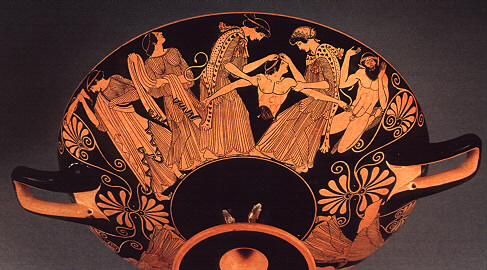
Dionysian Dithyramb

“Be that as it may, Tragedy – as also Comedy – was at first mere improvisation.
The one originated with the authors of the Dithyramb,
the other with those of the phallic songs,
which are still in use in many of our cities.”
[Aristotle]

DithyrambThe cult came from the east.
No one knew where it originated.
Women left their homes by night and wandered in the mountains.
Men adopted feminine mannerisms.
Reflection yielded to participation.
The Classic moment passed as an unknown god gathered followers
in the groves of madness.
The youth were sure they were on the cutting edge of liberation.
The elders clucked and scolded as society unraveled.
A god of youth and frenzy subverted the order of the ancient days –
but they called it freedom in ecstasy.
The idol Dionysus reigned as the culture imploded.
And yet it took several generations –
and each successive generation was sure they were breaking with a useless past
and dancing, hypnotized, into a glorious future.

With the degeneration of the Classical period, new forms of music and rhythm rose to popularity as plebeian slave-values became widespread in a general reaction against the Patrician and administrative governing classes. The street musicians, often affecting the manner of the criminal underclass, sang popular airs to simple rhythmic accompaniment, often with prostitutes or priestesses dancing to attract passers-by. Such musicians were in abundance on feast days and during civic festivals, and the ribald content which was their staple, often inflamed certain sectors of the urban populace to moral outrage.

But that was long ago…