Blasón

José Santos Chocano (1875-1934)

Soy el cantor de América autóctono y salvaje:
mi lira tiene un alma, mi canto un ideal.
Mi verso no se mece colgado de un ramaje
con vaivén pausado de hamaca tropical…

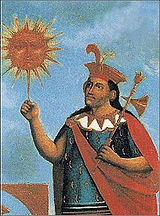
Cuando me siento inca, le rindo vasallaje
al Sol, que me da el cetro de su poder real;
cuando me siento hispano y evoco el coloniaje
parecen mis estrofas trompetas de cristal.
Mi fantasía viene de un abolengo moro:
los Andes son de plata, pero el león, de oro,
y las dos castas fundo con épico fragor.

La sangre es española e incaico es el latido;
y de no ser Poeta, quizá yo hubiera sido
un blanco aventurero o un indio emperador.

Coat of Arms

 I am the untamed voice of native America, 
my lyre has a soul, my song an ideal.
 My verse is not cradled and hung in the foliage
with the paused to-and-fro of a tropical hammock…
 When I’m feeling Inca, I pledge my vassalage
to the Sun, who offers the scepter of his royal power
 when I feel Hispanic and evoke colonial slavery
my verses sound like crystal trumpets.
My fantasy hails from Moorish lineage:
the Andes are of silver, but the Lion – of gold,
and the two are alloyed with an epic roar.
The blood is Spanish and the pulse is Inca;
and if not a Poet, I might well have been
A white adventurer or an Indian emperor.

La Kumbia Kalvinista

La Kumbia Kalvinista no es ritmo vaticano
se baila todo libre con la biblia en la mano

La Kumbia Kalvinista es la onda reformada
las sectas sí prometen—pero no entregan nada

Esta cumbia trascendente, pero poco conocida
es la cumbre de verdad y predestina pura vida

La Kumbia Kalvinista es la nueva nueva onda
la cantan las iglesias y ofrecen otra ronda

La Kumbia Kalvinista no lo bailan los de Roma
si un padre lo intenta terminará caído en coma

es un baile teológico que es absurdo mientras lógico
lo baila cada tribu, cada etnia y antropólogo

el papa mismo, y su esposa
bailan esta cumbia fabulosa
tu estado de animo no es nada
sino gracia predestinada

 lo bailan los sajones con cojones

 lo bailan las alemanas si le dan la ganas

este baile está basado en un ritmo luterano
apetece a los gringos, a los indios, y a fulano

no bailaban los franceses aunque Calvin era suya
si bailaban los escoceses y gritaban aleluya !


GRACIAS al SILABEITOR


¿Haiku?  pues… no sé.
es algo chino, yo creo.
Es un poema.

Latina en la tina

Wussup professional Latina ?
Diversity been good 2 U?
Water warm enuf 4 U?
Shaking down enough rich gringos to fund your Non-Profit?
(speak against capitalismo here)
Got time for la Revolución after your pedicure today?
(mention the border here)
still watching Oprah, Abuela?
heard from your third ex-husband recently?
Wussup, consummate professional.
(turn on NPR here)
Got nail polish? Got car waxed? Got investments?
(take a networking business lunch here)
Have you streaked your hair enuf?
(mention indigenismo here)
I hope you are caring well for all the nietos
and still have time to be a tiburona
(insert italicized Spanish word here)
How are all your gente ?
(mention mujeres fuertes here)
Hey Latina—when did you move out of the barrio ?
(mention La Raza here)
Mujer Latina—wussup ?
How is Gringolandia workin’ out 4 U ?
(turn off Univisión here)
’cause if the oppression gets too bad
you could always move back
to Venezuela
or Chihuahua
or San Juan,  or…
(mention Trump here)
…Miami?

(you hypocrite you)
Brightly shines the night
when Latinos count as white
(data-driven light)

Mexicanismo Posmodernista

In the Pre-Columbian and pre-patriarchal text above, the “Tía” clearly plays a radicalizing role in the context of narco-anarchy on the frontier. There is an intensification of the polarizing dynamic between striated regimentation in the person of the narrator who attempts to name, itemize, and commodify garments and the Tía herself who, as an empowered change agent, uses her radical femininity to challenge the patriarchy and the dominant hegemony of machismo within the outlaw context of narcotrafficking.

See Chandler on Barthes and the garment system:

1. She selects signs from three paradigms (i.e. sets of possible signs – upper body garments, lower body garments, and footwear). Each paradigm contains a possible set of pieces from which she can choose only one. From the upper-body-garment paradigm (including blouses, tee-shirts, tunics, sweaters), she selects one. These items share a similar structure, function, and/or other attribute with others in the set: they are related to one another on the basis of similarity. She further selects items related by similarity from the lower-body-garment and footwear paradigms. A socially defined, shared classification system or code shapes her selections.
2.  She combines the selected signs through rules (i.e., tee-shirts go with sandals, not high heels), sending a message through the ensemble – the syntagm. Selection requires her to perceive similarity and opposition among signs within the set (the paradigm), classifying them as items having the same function or structure, only one of which she needs. She can substitute, or select, a blouse for the tee-shirt – conveying a different message.
http://users.aber.ac.uk/dgc/Documents/S4B/sem03.html