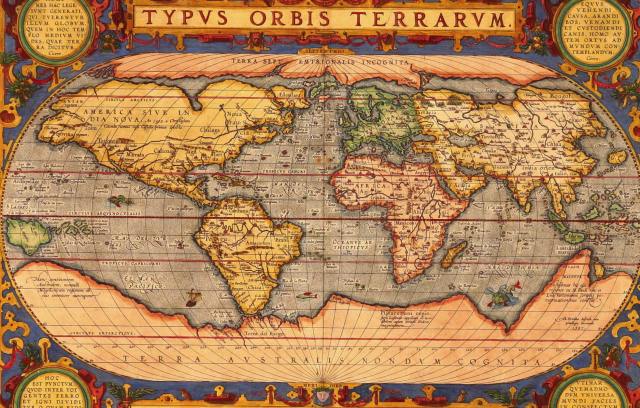
The Columbiad (pt 1)


Le mondeEvery circumstance relating to the discovery and settlement of America is an interesting object of inquiry, especially to the great and growing nations of this hemisphere, who owe their existence to those arduous labors. Yet it is presumed that many persons, who might be entertained with a poem on this subject, are but slightly acquainted with the life and character of the hero whose extraordinary genius led him to discover the continent, and whose singular sufferings, arising from that service, ought to excite the indignation of the world.

Christopher Columbus was born in Genoa about the year 1447, when the navigation of Europe was scarcely extended beyond the limits of the Mediterranean and the other narrow seas that border the great ocean. The mariner’s compass had been invented and in common use for more than a century; yet with the help of this sure guide, and prompted by a laudable spirit of discovery, the mariners of those days rarely ventured from the sight of land.

They acquired wonderful applause by sailing along the coast of Africa, and discovering some of the neighboring islands; and after pushing their researches with great industry for half a century, the Portuguese, who were the most fortunate and enterprising, extended their voyages southward no farther than the equator.

The rich commodities of the East had, for several ages, been brought into Europe by the Red Sea and the Mediterranean; and it had now become the object of the Portuguese to find a passage to India by sailing round the southern extremity of Africa, and then taking an eastern course. This great object engaged the general attention, and drew into the Portuguese service adventurers from the other maritime nations of Europe. Every year added to their experience in navigation, and seemed to promise some distant reward to their industry. The prospect however of arriving at India by that route was still by no means encouraging. Fifty years perseverance in the same track having brought them only to the equator, it was probable that as many more would elapse before they could accomplish their purpose.

(from the Introduction)

Joel Barlow: The Columbiad (1809)


Post-Columbiad: Barlow’s High Bar

Joel B

I learned that Joel Barlow began as a chaplain to the Continental Army during the Revolutionary War and ended as a Liberal who supported the French Revolution and dreamed of global government. He was a personal friend of both Thomas Jefferson and Tom Paine. Maybe some day I will read EVERY LINE of his Columbiad.

The Columbiad versifies about geological evidence contrary to the Christian creation story, describes the secular apocalypse that will come if Americans fail to emancipate their slaves, and ends with representatives of the major religions discarding the symbols of their faith to join into one world-governing council, based in a crystal palace in Mesopotamia.

The British reviewer  cited above tries to label Barlow as having become an atheist in the later stages of his life. Reading from  the last book of The Columbiad it seems doubtful to me, since true atheists don’t use this type of language. And yet the Aquila Report confirms this idea and holds Barlow up as America’s first acclaimed atheist in the public sphere.

Regardless of his beliefs and values, I still love Barlow’s poetry though I appear to be going against the current on that one. I love his use of lyrically obscure vocabulary. I love his broad range of pan-continental and environmental imagery. I love his lists of tributary rivers, empires, natural phenomena, kingdoms and historical personages. His poetry gets me very high.

But his global optimism and his sense of inevitable moral progress is so pronounced that it is depressing—to contrast his lofty humanist dream of the world’s future to yesterday’s news is too much of a disjuncture. He really thought America was destined to democratically guide the nations of the world into a global republic based on reason and moral restraint. What would he say today? How far off was his vision? How far have we fallen and how much further is the descent ?

The end of this 9-volume poem has lots of gold to mine. This stuff begs to be satirized, I know, but I still love it. Just because we have degenerated to the point that we lack appreciation for his verse does not detract from its quality.

Poetically, Barlow set the bar quite high:

Thus Physic Science, with exploring eyes,
First o’er the nations bids her beauties rise,
Prepares the glorious way to pour abroad
Her Sister’s brighter beams, the purest light of God.
Then Moral Science leads the lively mind
Liberté
Thro broader fields and pleasures more refined;
Teaches the temper’d soul, at one vast view,
To glance o’er time and look existence thro,
See worlds and worlds, to being’s formless end,
With all their hosts on her prime power depend,
Seraphs and suns and systems, as they rise,
Live in her life and kindle from her eyes,
Her cloudless ken, her all-pervading soul
Illume, sublime and harmonize the whole;
Teaches the pride of man its breadth to bound
In one small point of this amazing round,
To shrink and rest where nature fixt its fate,
A line its space, a moment for its date;
Instructs the heart an ampler joy to taste,
And share its feelings with each human breast,
Expand its wish to grasp the total kind
Of sentient soul, of cogitative mind;
Till mutual love commands all strife to cease,
And earth join joyous in the songs of peace.

Thus heard Columbus, eager to behold
The famed Apocalypse its years unfold;
The soul stood speaking thro his gazing eyes,
And thus his voice: Oh let the visions rise!
Command, celestial Guide, from each far pole,
John’s vision’d morn to open on my soul,
And raise the scenes, by his reflected light,
Living and glorious to my longing sight.
Let heaven unfolding show the eternal throne,
And all the concave flame in one clear sun;
On clouds of fire, with angels at his side,
The Prince of Peace, the King of Salem ride,
With smiles of love to greet the bridal earth,
Call slumbering ages to a second birth,
With all his white-robed millions fill the train,
And here commence the interminable reign!

from: The Columbiad, Book IX by Joel Barlow

I Guard the Flying Rear

Now the Peruvians, in collected might,
With one wide stroke had wing’d the savage flight
But their bright Godhead, in his midday race,
With glooms unusual veil’d his radiant face,
Quench’d all his beams, tho cloudless, in affright,
As loth to view from heaven the finish’d fight.
A trembling twilight o’er the welkin moves,
Browns the dim void, and darkens deep the groves;
The waking stars, embolden’d at the sight,
Peep out and gem the anticipated night…
When pious Capac to the listening crowd
Raised high his wand and pour’d his voice aloud:
Ye chiefs and warriors of Peruvian race,
Some sore offence obscures my father’s face;
What moves the Numen to desert the plain,
Nor save his children, nor behold them slain?
Fly! speed your course, regain the guardian town,
Ere darkness shroud you in a deeper frown;
The faithful walls your squadrons shall defend,
While my sad steps the sacred dome ascend,
To learn the cause, and ward the woes we fear:
Haste, haste, my sons! I guard the flying rear…

excerpt from: The Columbiad, Book III  by Joel Barlow

Inca Eclipse


Quito Rears Her Fanes…

Grupo Deseo: ECUADOR

The clime where Quito since hath rear’d her fanes,
And now no more her barbarous rites maintains.
He saw these vales in richer blooms array’d,
And tribes more numerous haunt the woodland shade…

Yet softer fires his daring views control,
And mixt emotions fill his changing soul.
Shall genius rare, that might the world improve,
Bend to the milder voice of careless love,
That bounds his glories, and forbids to part
From bowers that woo’d his fluctuating heart?
Or shall the toils imperial heroes claim
Fire his brave bosom with a patriot flame,Prisoners-of-Sun-inca-dream
Bid sceptres wait him on Peruvia’s shore,
And loved Oella meet his eyes no more?

Sudden his near approach the maid alarms;
He flew enraptured to her yielding arms,
And lost, dissolving in a softer flame,
His distant empire and the fire of fame.
At length, retiring thro the homeward field,
Their glowing souls to cooler converse yield;
O’er various scenes of blissful life they ran,
When thus the warrior to the maid began:
Long have we mark’d the inauspicious reignCapac round
That waits our sceptre in this rough domain;
A soil ungrateful and a wayward race,
Their game but scanty, and confined their space.
Where late my steps the southern war pursued,
The fertile plains grew boundless as I view’d;
More numerous nations trod the grassy wild,
And joyous nature more delightful smiled…


The Argument: Natives of America appear in vision.
Their manners and characters. Columbus demands the cause of the dissimilarity of men in different countries, Hesper replies, That the human body is composed of a due proportion of the elements suited to the place of its first formation; that these elements, differently proportioned, produce all the changes of health, sickness, growth and decay; and may likewise produce any other changes which occasion the diversity of men; that these elemental proportions are varied, not more by climate than temperature and other local circumstances; that the mind is likewise in a state of change, and will take its physical character from the body and from external objects: examples. Inquiry concerning the first peopling of America.

excerpts from: The Columbiad, Book II  by Joel Barlow

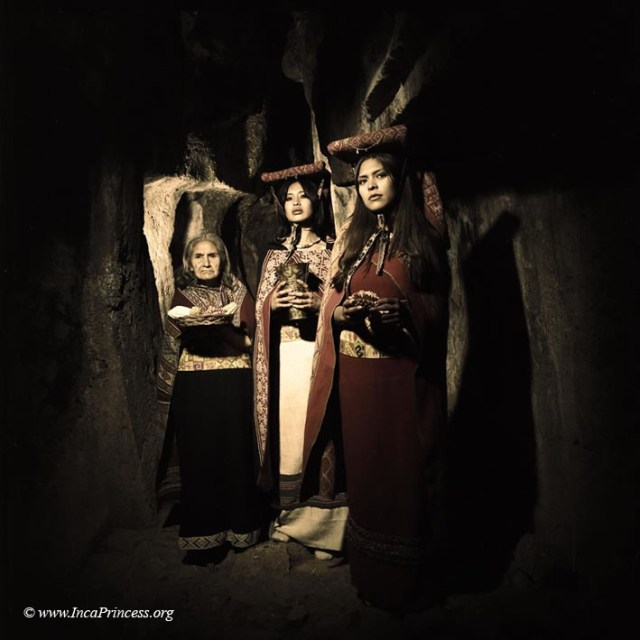
Princesas