Blasón

José Santos Chocano (1875-1934)

Soy el cantor de América autóctono y salvaje:
mi lira tiene un alma, mi canto un ideal.
Mi verso no se mece colgado de un ramaje
con vaivén pausado de hamaca tropical…

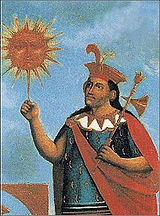
Cuando me siento inca, le rindo vasallaje
al Sol, que me da el cetro de su poder real;
cuando me siento hispano y evoco el coloniaje
parecen mis estrofas trompetas de cristal.

Mi fantasía viene de un abolengo moro:
los Andes son de plata, pero el león, de oro,
y las dos castas fundo con épico fragor.

La sangre es española e incaico es el latido;
y de no ser Poeta, quizá yo hubiera sido
un blanco aventurero o un indio emperador.

Coat of Arms

 I am the untamed voice of native America, 
my lyre has a soul, my song an ideal.
 My verse is not cradled and hung in the foliage
with the paused to-and-fro of a tropical hammock…
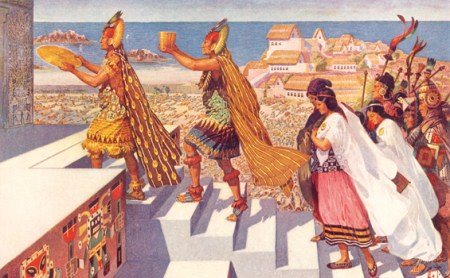
 When I’m feeling Inca, I pledge my vassalage
to the Sun, who offers the scepter of his royal power
 when I feel Hispanic and evoke colonial slavery
my verses sound like crystal trumpets.
My fantasy hails from Moorish lineage:
the Andes are of silver, but the Lion – of gold,
and the two are alloyed with an epic roar.
The blood is Spanish and the pulse is Inca;
and if not a Poet, I might well have been
A white adventurer or an Indian emperor.

Muñequita

Could but her sacred name, unknown so long,
Rise, like her labors, to the son of song,
To her, to them, I’d consecrate my lays,
And blow her pudding with the breath of praise.
If ’twas Oella, whom I sang before,
I here ascribe her one great virtue more.
Not through the rich Peruvian realms alone
The fame of Sol’s sweet daughter should be known,
But o’er the world’s wide climes should live secure,
Far as his rays extend, as long as they endure…

[ The Hasty Pudding, by Joel Barlow, 1796 ]

Gnostic Gnonsense & Andean Vistas

Lest fellow members of the body misconstrue my Andean longings,
let us comprehend, O loyal connectees, the corporeal metaphor
sublimated, transmuted into empyrean fire and rendered universal
by St. Paul of Tarsus the founder of our holy and elect communities,
when he wrote:

All flesh is not the same flesh: but there is one kind of flesh of men, another flesh of beasts, another of fishes, and another of birds. There are also celestial bodies, and bodies terrestrial: but the glory of the celestial is one, and the glory of the terrestrial is another. There is one glory of the sun, and another glory of the moon, and another glory of the stars: for one star differeth from another star in glory. So also is the resurrection of the dead. It is sown in corruption; it is raised in incorruption: It is sown in dishonour; it is raised in glory: it is sown in weakness; it is raised in power.
[I Corinthians 15:39-43]

The decentralized undulating landscapes of terrestrial desire can be confused with celestial bodies, yes, but the astral bodies are free from carnal taint. And it is only in the night devoid of lunar light that the celestial bodies may be clearly glimpsed…

But enough gnostic gnonsense —

let us depart for the lyrical peaks of the Andes with Joel Barlow as our guide.
Capac and Oella await us there on the distant and sacred summit.
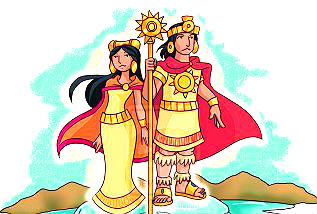
capac & oella

Fixing our sight on those majestic heights,
we nonetheless begin the ascent
through Amazonian  jungle headwaters.

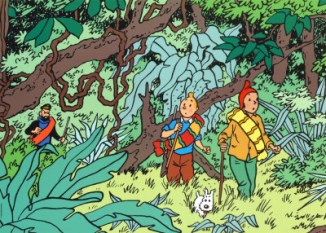
TT Broken Ear

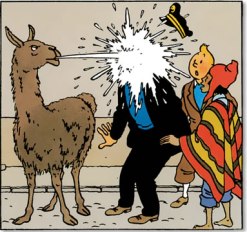
 Our llamas are well-provisioned with coca, pisco and papas

Tintin en la selva     Prisoners of the Sun LLAMA

IMAGE CREDIT: Hergé – Prisoners of the Sun / The Broken Ear
landesfes / Caroline Savard @ Deviant ART
 

Mountains of Music

I bought this album on cassette at an open-air market near Tacubaya train station when I visited Mexico City in 1998. The music entered my soul, and it helped me learn Spanish. I had always loved Inca Flute music but I was not aware of all the contemporary variations that exist. It can be confusing; the style called Cumbia Andina is actually a Mexican spin-off from true Andean folkloric music. It is also different from, though related to Chicha, which is pop/rock cumbia from the Andes. I love all of this music, although I did not grow up with it and don’t know a wide variety of groups.

Wikipedia explains:

Peruvian cumbia, particularly from the 1960s to mid-1990s, is generally known as “Chicha”, although this definition is quite problematic as both Peruvian cumbia and Chicha currently co-exist and influence each other   […]
Peruvian cumbia started in the 1960s with groups such as Los Destellos, and later with Juaneco y Su Combo, Los Mirlos, Los Shapis, Cuarteto Continental, Los Diablos Rojos, Pintura Roja, Chacalon y la Nueva Crema and Grupo Néctar. Some musical groups that play Peruvian cumbia today are: Agua Marina, Armonia 10, Agua Bella, and Grupo 5. These groups would be classified as Cumbia but often take songs and techniques from Chicha and Huayno in their stylings or as songs. Grupo Fantasma was a Peruvian-Mexican cumbia group. Andean Cumbia, is a style that combines Andean music and cumbia. This style has even become popular in Mexico, as some groups like Grupo Saya claim to be Cumbia andina mexicana, Mexican Andean Cumbia.