The Lying Poets (Pt. 1)

London after Midnight

“Since I have known the body better” – said Zarathustra to one of his disciples – “the spirit has only been to me symbolically spirit; and all the ‘imperishable’ – that is also but a simile.”

“So have I heard you say once before,” answered the disciple, ” and then you added: ‘But the poets lie too much.’ Why didst you say that the poets lie too much?”

“Why?” said Zarathustra. “you ask why? I do not belong to those who may be asked after their Why. Is my experience but of yesterday? It is long ago that I experienced the reasons for my opinions. Should I not have to be a cask of memory, if I also wanted to have my reasons with me? It is already too much for me even to retain my opinions; and many a bird flies away. And sometimes, also, do I find a fugitive creature in my dovecote, which is alien to me, and trembles when I lay my hand upon it. But what did Zarathustra once say to you? That the poets lie too much? – But Zarathustra also is a poet. Do you believe that he there spoke the truth? Why do you believe it?”

The disciple answered: “I believe in Zarathustra.” But Zarathustra shook his head and smiled.
“Belief does not sanctify me”, said he, “least of all the belief in myself. But granting that someone did say in all seriousness that the poets lie too much: he was right – we do lie too much.”

from: Thus Spoke Zarathustra  by  F. Nietzsche (Ed: Bill Chapko)

Zarathustra’s Stately Idol

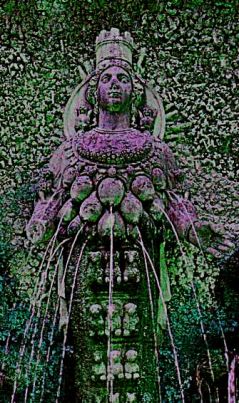
Diana of Ephesus1

Somewhere there are still peoples and herds, but not where we live, my brothers:
here there are states. State? What is that? Well then, open your ears to me,
for now I shall speak to you about the death of peoples.

State is the name of the coldest of all cold monsters.
Coldly it tells lies too; and this lie crawls out of its mouth:
I, the state, am the people.
That is a lie! It was creators who created peoples
and hung a faith and a love over them: thus they served life.

It is annihilators who set traps for the many and call them state:
they hang a sword and a hundred appetites over them.

Where there is still a people, it does not understand the state
and hates it as the evil eye and the sin against customs and rights.

This sign I give you: every people speaks its tongue of good and evil, which the neighbor does not understand. It has invented its own language of customs and rights. But the state tells lies in all the tongues of good and evil; and whatever it says it lies—and whatever it has it has stolen. Everything about it is false; it bites with stolen teeth, and bites easily. Even its entrails are false. Confusion of tongues of good and evil: this sign I give you as the sign of the state. Verily, this sign signifies the will to death. Verily, it beckons to the preachers of death.

from Thus Spoke Zarathustra: A Book for All and None
tr. Walter Kaufmann: 1995 Random House

credit: www.killian.com

Data-Baiting Data-Hooks

The ability to tell the story of numbers –
to extract meaning from spreadsheets and analytics reports,
to tease out insights from seeming mountains of data –

Arment Dietrich

One of the most powerful, understated skills of the future in marketing
is the person who can generate insight from data.

Christopher S. Penn

It’s about infusing data with meaning:
pre-dating outdated data;
liberating data from the catchment base
and stocking the data-pool
while re-stocking the data-bar,
then raising  that same data-bar
until the data jumps over it
so we catch the information
as the benchmarks are liberated.

Please mark all data
before throwing it back in the data-pool
in order to facilitate
tracking, hunting and fishing of future data
without endangering
the target population.

Poetic Data